Pencilfish
This page is educational reference material for preparing questions. A licensed veterinarian examines the animal, makes the diagnosis, and sets the treatment.
Affiliate links may earn a commission. Affiliate disclosure.
Quick Facts
| Attribute | Details |
|---|---|
| Scientific Name | Nannostomus spp. |
| Origin | South America (Amazon basin) |
| Size | 1-2.5 inches (2.5-6 cm) |
| Lifespan | 3-5 years |
| Temperature | 72-82°F (22-28°C) |
| pH | 5.5-7.0 |
| Tank Size | 10+ gallons (school of 6+) |
| Care Level | Easy to Moderate |
| Diet | Omnivore (micro-predator) |
| Temperament | Peaceful, Schooling |
Recommended for Pencilfish
Chewy - Micro pellets & frozen foods | Petco - Planted tank supplies | PetSmart - Nano aquarium kits
Overview
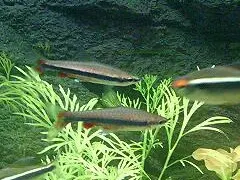
Pencilfish are slender, elegant characins named for their elongated, pencil-like body shape. These peaceful nano fish are prized for their subtle beauty, interesting swimming posture, and calm demeanor. Many species swim at an oblique angle, giving them a distinctive appearance.
A unique feature of Pencilfish is their dramatic color change between day and night. Many species display horizontal stripes during the day that transform into vertical bars at night - a camouflage adaptation that makes them fascinating to observe at different times.
Pencilfish are Nannostomus from Amazon drainages, slim fish of 1 to 2.5 inches that often hover on a slight diagonal in still water. A school in soft water lives about 3 to 5 years. The tank minimum is 10 gallons for a school of six or more. They are peaceful, and they are listed as easy to moderate because the school and the water are the actual requirements, not because the fish is aggressive.
A lone pencilfish fades into a corner and stops showing the horizontal stripe that makes the group worth keeping. Six is the floor on the card, and a longer tank than a tall 10-gallon jar lets the school move. Soft cover from fine plants and a bit of tannin suits them. A bare, blasting community tank with large active barbs turns pencilfish into food or into fish that never leave the back corner.
Water is soft and slightly acidic to neutral: pH 5.5 to 7.0, hardness 2 to 10 dGH, temperature 72 to 82°F. Ammonia at 0 ppm and nitrite at 0 ppm are the usual line, and nitrate should stay under 20 ppm. They are not the fish to cycle a tank with. Add them after the filter is already holding those zeros. A sudden alkaline buffer from a handful of crushed coral will sit outside the hardness range and dull the group.
Natural Habitat
Pencilfish originate from South American waters.
- Range: Amazon basin, Orinoco, and Guiana Shield drainages
- Environment: Slow-moving streams, flooded forests, and blackwater habitats
- Water: Soft, acidic, often tannin-stained water
- Habitat: Among dense vegetation and submerged leaf litter
Species Varieties
Several Pencilfish species are popular in aquariums.
- Coral Red Pencilfish (N. mortenthaleri): Stunning red coloration; most colorful species
- Golden Pencilfish (N. beckfordi): Golden body with red accents; most common
- Dwarf Pencilfish (N. marginatus): Tiny at 1.2 inches; great for nano tanks
- Three-lined Pencilfish (N. trifasciatus): Three horizontal stripes
- One-lined Pencilfish (N. unifasciatus): Single bold horizontal stripe
- Purple Pencilfish (N. rubrocaudatus): Purple/red tail coloration
Tank Requirements
Pencilfish thrive in well-planted aquariums.
- Tank Size: Minimum 10 gallons for a school of 6-8
- Plants: Heavily planted with fine-leaved plants
- Floating Plants: Provide shade and security
- Substrate: Dark substrate enhances coloration
- Filtration: Gentle filtration; avoid strong currents
- Lighting: Subdued to moderate; diffused through floating plants
- Decor: Driftwood and leaf litter for blackwater effect
Water Parameters
Pencilfish prefer soft, acidic conditions: Your aquatic veterinarian and experienced Pencilfish owners can offer perspective tailored to your situation.
| Parameter | Ideal Range |
|---|---|
| Temperature | 72-82°F (22-28°C) |
| pH | 5.5-7.0 |
| Hardness (GH) | 2-10 dGH |
| Ammonia | 0 ppm |
| Nitrite | 0 ppm |
| Nitrate | <20 ppm |
Diet & Feeding
- Staple Food: High-quality micro pellets or crushed flakes
- Live Foods: Baby brine shrimp, daphnia, micro worms
- Frozen Foods: Cyclops, daphnia, baby brine shrimp
- Important: Food must be small enough for their tiny mouths
- Variety: Rotate foods for optimal nutrition
Feeding Schedule: Feed 2-3 small meals daily; they pick at food throughout the day.
Proper nutrition for Pencilfish requires understanding not just what to feed, but how feeding strategies affect health, behavior, and water quality. A disciplined approach to feeding, where your Pencilfish receives the right amount of appropriate food at consistent intervals, is one of the most impactful things you can do for both the fish and the overall aquarium ecosystem.
Diet variety is essential for optimal Pencilfish health because no single commercial food provides the complete nutritional profile these fish require. Observing your Pencilfish's response to different food types also provides useful health information, as reduced interest in normally preferred foods is often an early indicator of illness.
Behavior & Social Structure
Pencilfish display interesting behaviors: The Pencilfish's behaviour usually tells you within a few weeks whether the routine fits — adjust the routine before trying to adjust the animal.
- Schooling: Should be kept in groups of 6+ for security
- Swimming Angle: Many species swim at an oblique (head-up) angle
- Peaceful: Non-aggressive toward all tank mates
- Day/Night Colors: Dramatic pattern changes between day and night
- Territorial Males: Males may display to each other but rarely fight
The diet line calls them omnivores and micro-predators. They pick at tiny foods in the water column. Crushed flake is a start. Baby brine shrimp, cyclops, and other small frozen foods are what put weight on a 2-inch fish that loses a race to bigger mouths. Feed where the school actually hovers, not only at the front glass where the gourami takes it all. Several species in the genus differ in stripe and in how strongly they tilt. The care envelope above covers the group sold as pencilfish.
Temperament is peaceful and schooling, which means the danger is from tankmates, not from the pencilfish. Avoid fin-nippers and anything large enough to treat a 1-inch juvenile as a snack. A planted 10-gallon with a calm school can work. A 10-gallon that already holds a betta, a school of something else, and these fish does not. Give the six their own space or move the group into a larger tank that still respects the soft-water numbers.
Feeding behavior in Pencilfish reveals much about their ecological role and can be leveraged by keepers to promote natural behaviors and reduce aggression. Observing when, where, and how your Pencilfish feeds provides diagnostic information about their comfort level, health status, and social standing. Many successful Pencilfish keepers use varied feeding strategies including target feeding, scatter feeding, and enrichment feeders to promote natural foraging behaviors and reduce competition-related stress.
Compatibility
Pencilfish make excellent community fish.
Compatible Tank Mates
- Small tetras (Cardinal, Ember, Green Neon)
- Corydoras catfish
- Otocinclus
- Small rasboras
- Dwarf cichlids (Apistogramma)
- Other Pencilfish species
- Peaceful dwarf shrimp
Incompatible Species
- Large or aggressive fish
- Fast-moving fin nippers
- Fish that outcompete for food
- Boisterous species that cause stress
Breeding
Pencilfish can be bred with effort: For practical care decisions, Pencilfish-specific advice produces better outcomes than generalised pet content.
- Sexing: Males more colorful; females rounder when gravid
- Setup: Heavily planted breeding tank with fine-leaved plants
- Spawning: Scatter eggs among plants in early morning
- Eggs: Adhesive eggs stick to plants; remove parents after spawning
- Fry: Hatch in 24-48 hours; feed infusoria then baby brine shrimp
Common Health Issues
Pencilfish are generally hardy but can experience.
- Ich: Common parasite; treat with temperature increase and medication
- Stress: From poor water quality or inadequate school size
- Fin Rot: Usually from poor conditions
- Internal Parasites: Possible in wild-caught specimens
- Nutritional Issues: If not fed appropriately sized foods
Health & Care Products
Chewy - Micro foods & supplements | Petco - Water test kits | 1-800-PetMeds - Fish medications
For Pencilfish, prevention is always better than treatment.
Recognizing early signs of disease in Pencilfish requires a trained eye and consistent observation. Establishing a daily observation routine—even just a few minutes of focused attention during feeding—helps you develop a baseline understanding of what normal behavior looks like for your specific Pencilfish, making deviations immediately apparent.
Quarantine protocols represent one of the most impactful health management practices available to Pencilfish keepers. This single practice prevents the majority of disease outbreaks in established aquariums and is considered essential by virtually all experienced Pencilfish keepers.
Is This Fish Right for You?
Quiet parts of a Pencilfish's care plan reward the discipline to handle them on schedule rather than on demand.
Pencilfish Are Great For:
- Planted nano aquarium setups
- Peaceful community tanks
- Aquarists who appreciate subtle beauty
- Blackwater or biotope aquariums
Pencilfish May Not Be Ideal For:
- Tanks with aggressive or boisterous fish
- High-flow or bare-bottom setups
- Those wanting very active, flashy fish
- Hard, alkaline water conditions
Adding a Pencilfish to your setup works best when you have honestly evaluated your tank size, maintenance habits, and budget.
Experienced Pencilfish keepers will tell you that the learning curve is steepest in the first few months. After that, maintenance becomes routine.
Cost of Ownership
These figures are averages, not guarantees. Some Pencilfish owners spend less; others spend more due to health complications or premium product preferences.
The true cost of keeping Pencilfish extends well beyond the initial purchase price and basic equipment. Many aspiring Pencilfish keepers underestimate these ongoing costs, which can lead to cut corners that ultimately compromise fish health and result in even greater expenses. A realistic budget that accounts for both routine maintenance and occasional replacement of equipment provides a more accurate picture of what Pencilfish keeping actually costs.
Heaters, filters, lights, and pumps all have finite lifespans, and their failure—particularly heater or filter failure—can have catastrophic consequences for Pencilfish if not addressed promptly. Many experienced Pencilfish keepers also invest in battery-operated air pumps and backup heaters as insurance against power outages, which can be lethal to tropical species within hours depending on ambient room temperature.
The cost-benefit analysis of quality versus budget equipment deserves careful consideration for Pencilfish keepers. This is particularly true for Pencilfish, where the animals themselves, along with any tank mates, plants, and established biological filtration, represent a significant investment of both money and time that is worth protecting with reliable equipment.
Related Species
If you're interested in Pencilfish, you might also consider.
- Hatchetfish - Another unique characin
- Killifish - Colorful small fish
- Endler's Livebearer - Active nano fish
- White Cloud Mountain Minnow - Hardy small schooling fish
Ask Our AI About Pencilfish
Have specific questions about Pencilfish care, species selection, or tank setup? Our AI assistant can provide personalized guidance.
Get Personalized AI Guidance
Pencilfish sustained welfare comes from parameter discipline, measured nutrition, and proper quarantine — not from ad-hoc intervention; these factors drive outcomes more than brand-name products.
Ask Our AI NowDecision Guides for Pencilfish
Use these only when comparing food, insurance, ownership budget, or beginner fit for this specific pet.