White Cloud Mountain Minnow
This page is educational reference material for preparing questions. A licensed veterinarian examines the animal, makes the diagnosis, and sets the treatment.
Affiliate links may earn a commission. Affiliate disclosure.
Quick Facts
| Attribute | Details |
|---|---|
| Scientific Name | Tanichthys albonubes |
| Origin | China (White Cloud Mountain, Guangdong) |
| Size | 1.5 inches (4 cm) |
| Lifespan | 5-7 years |
| Temperature | 60-72°F (15-22°C) |
| pH | 6.0-8.0 |
| Tank Size | 10+ gallons |
| Care Level | Easy |
| Diet | Omnivore |
| Temperament | Peaceful, Schooling |
Recommended for White Cloud Minnows
Chewy - Quality flake foods | Petco - Aquarium setups | PetSmart - Live plants & supplies
Overview
The White Cloud Mountain Minnow is one of the hardiest and most beginner-friendly fish in the aquarium hobby. Discovered in China in 1932, these small, peaceful fish are perfect for unheated aquariums and outdoor ponds in temperate climates. They were once called the "poor man's neon tetra" but have earned respect in their own right.
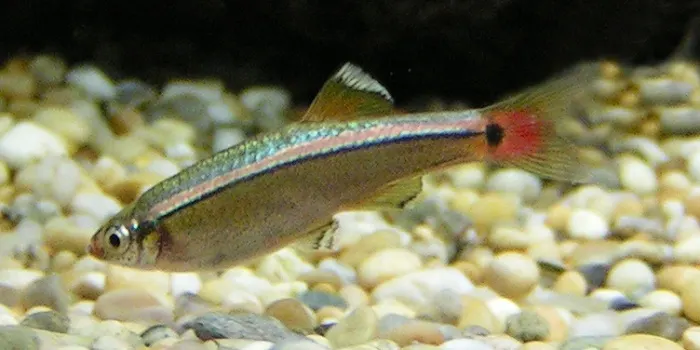
Their tolerance for cooler temperatures, ease of care, and beautiful coloration make them ideal for beginners, children's tanks, and experienced aquarists alike. They display attractive iridescent lateral lines and colorful fins.
Tanichthys albonubes comes from the White Cloud Mountain area of Guangdong in China, and the fish on this card is that species by name. Adults stay about 1.5 inches, or roughly 4 centimeters, and live 5 to 7 years. The tank is 10 gallons or more. Care is easy. The fish are peaceful, they school, and they eat an ordinary omnivore diet. The temperature line is more specific than a simple tropical range: 60 to 72°F, which is 15 to 22°C, with a note that they can tolerate a wider swing from about 40 to 80°F. Tolerance is not a target. The place they do well for years is the 60 to 72°F band, not a thermostat set near 80°F.
A long stay near 80°F, and certainly a community tank held at a tropical 82°F, sits outside both the preferred band and the stated tolerance. Do not park them in a discus or ram tank and point at the word tolerate. pH is 6.0 to 8.0 and hardness is 5 to 19 dGH, a wide mineral window that lets them live in ordinary tap water that would bother a soft-water tetra. Nitrate on this card should stay under 40 ppm. That ceiling is looser than some other small-fish pages. It is still a ceiling. Ammonia and nitrite do not get a pass because the fish is hardy. Both stay at 0 ppm.
They school. A 10-gallon tank with a planted length and a group large enough to occupy it is the easy setup. One or two fish skulk in the moss and never show the white-and-red fin flash that makes the species worth keeping. They spawn in cool water among fine leaves or a yarn mop, and a separate rearing tank is how you see the fry. The adults are not parental. Easy care includes a lid, because a 4-centimeter fish can still jump, and a filter gentle enough that the school is not pinned to one end of a small tank.
Natural Habitat
White Clouds originate from mountain streams in China.
- Location: White Cloud Mountain (Baiyun Shan), Guangdong Province, China
- Environment: Cool, clear mountain streams with moderate flow
- Status: Extinct in the wild (or nearly so) due to habitat loss
- Conservation: Thriving in aquarium populations worldwide
Varieties
Several varieties have been developed.
- Standard: Original wild-type coloration
- Golden: Gold/yellow body with original markings
- Long-fin: Extended finnage; various colors
- Meteor Minnow: Long-finned golden variety
Tank Requirements
White Clouds are adaptable but appreciate.
- Tank Size: Minimum 10 gallons for a school of 6-8
- Temperature: No heater needed in most homes; prefer cooler water
- Plants: Appreciate planted tanks with some open swimming space
- Filtration: Gentle to moderate; enjoy some current
- Substrate: Any; natural gravel or sand
- Outdoor: Excellent for outdoor tubs/ponds in summer or year-round in mild climates
Water Parameters
White Clouds are extremely adaptable: Your aquatic veterinarian and experienced White Cloud Mountain Minnow owners can offer perspective tailored to your situation.
| Parameter | Ideal Range |
|---|---|
| Temperature | 60-72°F (15-22°C); tolerate 40-80°F |
| pH | 6.0-8.0 |
| Hardness (GH) | 5-19 dGH |
| Ammonia | 0 ppm |
| Nitrite | 0 ppm |
| Nitrate | <40 ppm |
Temperature Note
White Cloud Minnows are coldwater fish and actually do poorly in warm tropical tanks. They thrive at room temperature (65-72°F) and can tolerate temperatures down to 40°F briefly. Avoid temperatures above 80°F.
Diet & Feeding
White Clouds are easy to feed.
- Staple Food: Quality flake or micro pellet food
- Live Foods: Daphnia, brine shrimp, micro worms
- Frozen Foods: Bloodworms, brine shrimp
- Algae: Will graze on algae naturally
- Variety: Appreciate varied diet
Feeding Schedule: Feed 2 times daily; small amounts they consume in 2 minutes.
Proper nutrition for White Cloud Mountain Minnow requires understanding not just what to feed, but how feeding strategies affect health, behavior, and water quality. A disciplined approach to feeding, where your White Cloud Mountain Minnow receives the right amount of appropriate food at consistent intervals, is one of the most impactful things you can do for both the fish and the overall aquarium ecosystem.
Diet variety is essential for optimal White Cloud Mountain Minnow health because no single commercial food provides the complete nutritional profile these fish require. Observing your White Cloud Mountain Minnow's response to different food types also provides useful health information, as reduced interest in normally preferred foods is often an early indicator of illness.
Behavior & Social Structure
White Clouds display pleasant social behaviors.
- Schooling: Must be kept in groups of 6+; more is better
- Peaceful: Non-aggressive with all tank mates
- Active: Constantly swimming and exploring
- Males Display: Males display to each other and females
- Mid-Level Swimmers: Occupy middle to upper water column
The diet is unfussy omnivore food in small pieces. Flake, micro pellets, and frozen cyclops or baby brine all work. They feed in the open once the group feels safe. Hardness between 5 and 19 dGH means you do not need a remineralizing project unless your water is nearly pure rain. You do need a thermometer. An unheated tank in a house that drops into the 50s at night and a heated tank that never falls below 78°F are both misses for different reasons. Aim at 60 to 72°F and let the tolerance band cover a hot week or a cold room, not the design of the aquarium.
The scientific name matters when you are sorting this fish from other tiny cyprinids sold as mountain minnows. Tanichthys albonubes is the White Cloud Mountain fish from Guangdong, at 1.5 inches and 5 to 7 years, in 10 gallons or more. Gold and long-finned forms are the same species and the same temperature story. They are peaceful with other small, cool-water fish. They are the wrong school to add to a warm, fast tank of tiger barbs. Keep the group together, keep nitrate under 40 ppm, and treat 60 to 72°F as the range you actually set, with 40 to 80°F as the outside edge they can endure and not as the thermostat setting.
Feeding behavior in White Cloud Mountain Minnow reveals much about their ecological role and can be leveraged by keepers to promote natural behaviors and reduce aggression. Observing when, where, and how your White Cloud Mountain Minnow feeds provides diagnostic information about their comfort level, health status, and social standing. Many successful White Cloud Mountain Minnow keepers use varied feeding strategies including target feeding, scatter feeding, and enrichment feeders to promote natural foraging behaviors and reduce competition-related stress.
Compatibility
White Clouds work well with other peaceful coolwater fish.
Compatible Tank Mates
- Paradise fish (juvenile or peaceful specimens)
- Rosy barbs
- Weather loaches
- Corydoras (some species tolerate cool water)
- Hillstream loaches
- Other White Clouds
- Goldfish (in larger setups; may be outcompeted for food)
Incompatible Species
- Tropical fish requiring warm water (above 78°F)
- Large or aggressive fish
- Fish that will eat them
- Fin nippers
Breeding
White Clouds are easy to breed: Your aquatic veterinarian and experienced White Cloud Mountain Minnow owners can offer perspective tailored to your situation.
- Ease: Very easy; often spawn spontaneously
- Method: Egg scatterers; spawn in fine-leaved plants or spawning mops
- Parents: May eat eggs; remove adults or provide heavy plant cover
- Eggs: Hatch in 36-48 hours at 72°F
- Fry Care: Feed infusoria, then baby brine shrimp
- Temperature: Cooler temperatures slow development but often yield healthier fry
Common Health Issues
White Clouds are extremely hardy but can experience: Your aquatic veterinarian and experienced White Cloud Mountain Minnow owners can offer perspective tailored to your situation.
- Ich: Common parasite; often from temperature stress
- Fin Rot: Usually from poor water quality
- Stress: From high temperatures or inadequate school size
- Old Age: Natural decline after 5-7 years
- Bloat: Rare; usually from overfeeding
Health & Care Products
Chewy - Quality foods & supplies | Petco - Water test kits | 1-800-PetMeds - Fish medications
The foundation of White Cloud Mountain Minnow health management is water quality — full stop. Regular testing and diligent maintenance are your best tools.
Recognizing early signs of disease in White Cloud Mountain Minnow requires a trained eye and consistent observation. Establishing a daily observation routine—even just a few minutes of focused attention during feeding—helps you develop a baseline understanding of what normal behavior looks like for your specific White Cloud Mountain Minnow, making deviations immediately apparent.
Quarantine protocols represent one of the most impactful health management practices available to White Cloud Mountain Minnow keepers. This single practice prevents the majority of disease outbreaks in established aquariums and is considered essential by virtually all experienced White Cloud Mountain Minnow keepers.
Is This Fish Right for You?
White Cloud Minnows Are Great For:
- Complete beginners to fishkeeping
- Unheated/room temperature aquariums
- Outdoor summer ponds or year-round in mild climates
- Children's aquariums (supervised)
- Low-maintenance setups
White Cloud Minnows May Not Be Ideal For:
- Heated tropical community tanks
- Tanks with large or aggressive fish
- Those wanting only 1-2 fish (need schools)
- Very warm climates without cooling
Aquarium keeping is a hobby of specifics, and White Cloud Mountain Minnow is no exception.
If you can commit to the maintenance schedule and the initial investment in proper equipment, a White Cloud Mountain Minnow is likely to reward you with an engaging, long-term addition to your aquarium.
Cost of Ownership
These White Cloud Mountain Minnow cost estimates give you a solid starting point, but real-world expenses vary by location, health status, and personal choices. Building in some buffer for unplanned expenses is always a good idea.
The true cost of keeping White Cloud Mountain Minnow extends well beyond the initial purchase price and basic equipment. Many aspiring White Cloud Mountain Minnow keepers underestimate these ongoing costs, which can lead to cut corners that ultimately compromise fish health and result in even greater expenses. A realistic budget that accounts for both routine maintenance and occasional replacement of equipment provides a more accurate picture of what White Cloud Mountain Minnow keeping actually costs.
Heaters, filters, lights, and pumps all have finite lifespans, and their failure—particularly heater or filter failure—can have catastrophic consequences for White Cloud Mountain Minnow if not addressed promptly. Many experienced White Cloud Mountain Minnow keepers also invest in battery-operated air pumps and backup heaters as insurance against power outages, which can be lethal to tropical species within hours depending on ambient room temperature.
The cost-benefit analysis of quality versus budget equipment deserves careful consideration for White Cloud Mountain Minnow keepers. This is particularly true for White Cloud Mountain Minnow, where the animals themselves, along with any tank mates, plants, and established biological filtration, represent a significant investment of both money and time that is worth protecting with reliable equipment.
Related Species
If you're interested in White Cloud Minnows, you might also consider.
- Rosy Barb - Another coolwater schooling fish
- Gold Barb - Hardy and adaptable
- Endler's Livebearer - Small, colorful alternative
- Pencilfish - Peaceful small fish
Ask Our AI About White Cloud Mountain Minnows
Have specific questions about White Cloud care, temperature requirements, or breeding? Our AI assistant can provide personalized guidance.
Get Personalized AI Guidance
A 5-to-7-year life at this size is a quiet success and it depends on not cooking the school. If the only aquarium you run is a lidded tropical tank, choose a different 1.5-inch fish. If you have a cool shelf and 10 gallons, this is one of the easier schooling species on the list, provided the school is big enough to behave like one and the water stays inside the hardness and pH window without drifting into a neglected nitrate pile above 40 ppm.
Ask Our AI NowDecision Guides for White Cloud Mountain Minnow
Use these only when comparing food, insurance, ownership budget, or beginner fit for this specific pet.