Nerite Snail
This page is educational reference material for preparing questions. A licensed veterinarian examines the animal, makes the diagnosis, and sets the treatment.
Affiliate links may earn a commission. Affiliate disclosure.
Quick Facts
| Attribute | Details |
|---|---|
| Scientific Name | Neritina sp. (multiple species) |
| Origin | Worldwide coastal and freshwater regions |
| Size | 0.5-1.5 inches (1-4 cm) |
| Lifespan | 1-3 years |
| Care Level | Easy |
| Tank Size | 5+ gallons |
| Temperature | 72-78°F (22-26°C) |
| pH Range | 7.0-8.5 |
| Breeding | Cannot breed in freshwater |
Recommended for Nerite Snails
Chewy - Algae wafers & supplements | Aquarium Co-Op - Healthy nerites & supplies | Buce Plant - Live plants for grazing
Overview
Nerite Snails are the undisputed champions of freshwater algae control. These small but mighty snails are voracious algae eaters with beautiful shell patterns, and best of all - they cannot reproduce in freshwater, eliminating concerns about population explosions.
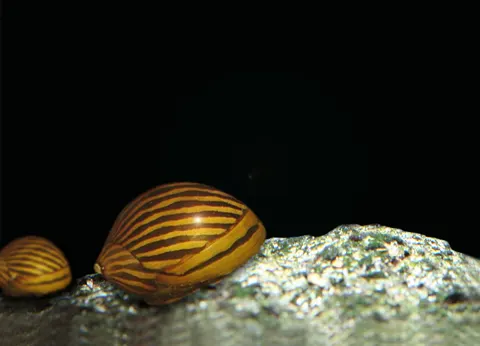
Available in numerous striking varieties including Zebra, Tiger, Olive, Horned, and Red Racer patterns, Nerite Snails combine functionality with aesthetics. They're a must-have for anyone battling algae in planted tanks or wanting natural, effective cleanup crew members.
Nerite snails sold for freshwater tanks belong to Neritina and Vittina. They stay small, about 0.5 to 1.5 inches, live 1 to 3 years, and are rated easy in a tank of 5 gallons or more. The fact people discover later is on the breeding line: they cannot breed in freshwater. Females still lay hard white eggs on wood, glass, and rocks. Those eggs do not hatch in a freshwater aquarium. Scraping them off is cosmetic. Waiting for a crop of baby nerites will not work, and it does not make these snails assassins.
Assassin snails are a different family with a different job. A nerite is a grazer. It needs biofilm and algae on hard surfaces, plus calcium for the shell. In a brand-new tank that is still spotless, a nerite starves while the glass looks clean. Supplement with algae wafers or blanched greens if the tank is too tidy, and do not keep a crowd of them in a small aquarium that has already been wiped down to bare glass.
The preferred pH on the card is 7.5 to 8.5, with a wider listed range of 7.0 to 8.5. Hardness should sit around 8 to 15 dGH and carbonate hardness around 5 to 12 dKH. Temperature is a bit cooler than many tropical cards, 72 to 78°F. Soft, hot, acidic water etches the shell and shortens that 1-to-3-year life. Ammonia at anything above 0 ppm, or nitrite above 0 ppm, is already too much. The tank they share should keep nitrate under 20 ppm.
Natural Habitat
Nerite Snails have diverse origins.
- Distribution: Coastal areas worldwide - Africa, Asia, Pacific Islands
- Environment: Brackish estuaries, tidal zones, and some freshwater streams
- Breeding: Larvae require saltwater to develop (why they don't breed in freshwater)
- Substrate: Rocky surfaces with algae growth
Tank Requirements
Nerite Snails are adaptable but have some needs.
- Tank Size: 5+ gallons; one snail per 5 gallons is a good rule
- Substrate: Any type; they primarily graze surfaces
- Surfaces: Glass, rocks, driftwood, and plant leaves for grazing
- Filtration: Standard filtration; they add minimal bioload
- Lid: Recommended - they may escape, especially at night
- Plants: Safe with all plants; won't damage healthy tissue
Water Parameters
| Parameter | Ideal Range |
|---|---|
| Temperature | 72-78°F (22-26°C) |
| pH | 7.5-8.5 |
| GH (General Hardness) | 8-15 dGH |
| KH (Carbonate Hardness) | 5-12 dKH |
| Ammonia | 0 ppm |
| Nitrite | 0 ppm |
| Nitrate | <20 ppm |
Avoid Acidic Water
Nerite Snails are sensitive to acidic water (pH below 7.0). Low pH will erode their shells over time. If keeping in planted tanks with CO2 injection, monitor pH carefully and supplement calcium.
Diet & Feeding
Nerite Snails are specialized algae eaters.
- Primary Diet: Algae - their main and preferred food source
- Algae Types: Green spot, green dust, diatoms, soft algae
- Supplemental Foods: Algae wafers if tank algae is insufficient
- Blanched Vegetables: Zucchini, cucumber, spinach
- Biofilm: Will graze on biofilm when algae is scarce
- Calcium: Cuttlebone or calcium blocks for shell health
Note: Nerites won't eat black beard algae or hair algae effectively.
Nerite Snail the three variables that move outcomes most are water stability, feeding discipline, and careful handling of new stock; these factors drive outcomes more than brand-name products.
Behavior & Temperament
Nerite Snails exhibit interesting behaviors: Your aquatic veterinarian and experienced Nerite Snail owners can offer perspective tailored to your situation.
- Peaceful: Cannot harm any tankmates
- Nocturnal: Often more active at night
- Escape Artists: May climb out of water; usually return
- Methodical Grazers: Systematically clean surfaces
- Righting: Can right themselves when flipped (most of the time)
- Hibernation: May become inactive for periods, then resume activity
They are poor at righting themselves if they fall onto the sand and land aperture-up, and a nerite stuck on its back under a decoration can die in a closed shell. Place them on the glass or on rock when you add them. They also crawl out of the water and can dry on the rim if the lid is loose. Zebra, olive, and horned nerites differ in pattern more than in care. None of them will control a hydra outbreak or hunt other snails.
Because the eggs never hatch in freshwater, the population you buy is the population you keep, minus natural deaths. That makes them a better choice than ramshorns when you want a set number of grazers. It also means a tank with no biofilm and a strict no-feed policy is a slow way to lose a 1-inch snail. Give them surfaces that are allowed to grow a film, mineral content in the ranges above, and no copper in the water.
Using this as a starting point, the day-to-day decisions about feeding, activity, preventive care, and mental stimulation are easier to land
Popular Varieties
Nerite Snails come in many beautiful patterns.
- Zebra Nerite: Black and gold striped pattern
- Tiger Nerite: Orange/yellow with dark stripes
- Olive Nerite: Solid olive/green coloration
- Horned Nerite: Features distinctive horn-like projections
- Red Racer Nerite: Reddish shell with racing stripes
- Black Racer Nerite: Dark with golden track marks
- Batik Nerite: Intricate maze-like patterns
Compatibility
Nerite Snails are compatible with nearly everything.
Good Tankmates
- All community fish
- Shrimp (all species)
- Other snails (Mystery, Ramshorn)
- Betta fish (safe)
- African Dwarf Frogs
- Corydoras and plecos
Avoid
- Loaches (will eat snails)
- Puffers (snail specialists)
- Crayfish and large crabs
- Assassin Snails (will prey on Nerites)
- Large, aggressive cichlids
Breeding
Nerite Snails have unique breeding requirements.
- Freshwater Breeding: CANNOT reproduce in freshwater
- Eggs: Will lay white sesame-seed-like eggs on hard surfaces
- Egg Viability: Eggs won't hatch without brackish/saltwater
- Egg Removal: Difficult to remove; scraping can damage surfaces
- Larval Stage: Requires marine conditions for development
Egg Laying Note
While Nerites can't breed in freshwater, females will still lay eggs - white dots that can be unsightly. These eggs won't hatch and will eventually deteriorate. Keeping only male Nerites prevents egg laying, but sexing is very difficult.
Health Issues
Common Nerite Snail health concerns.
- Shell Erosion: From acidic water or low calcium
- Stuck on Back: May need help righting in bare-bottom tanks
- Inactivity: Extended periods without movement (check water parameters)
- Escape Deaths: Can dry out if they escape tank
- Starvation: In very clean tanks with no algae
Signs of a Healthy Nerite
- Active movement around tank
- Strong shell without holes or pitting
- Firmly attached to surfaces
- Trapdoor closes when removed from water
Use tells you more than theory: a month in, you will know which parts of the plan to keep and which to skip.
Nerite Snails Are Perfect For:
- Anyone battling algae problems
- Planted tank enthusiasts
- Those who DON'T want snails breeding
- Beginners to invertebrates
- Aquarists wanting beautiful, functional snails
Nerite Snails May Not Be Ideal For:
- Soft, acidic water setups (below pH 7.0)
- Tanks with snail-eating fish
- Those bothered by unsightly eggs
- Very clean tanks without algae
Adding a Nerite Snail to your setup works best when you have honestly evaluated your tank size, maintenance habits, and budget.
Experienced Nerite Snail keepers will tell you that the learning curve is steepest in the first few months. After that, maintenance becomes routine.
Cost of Ownership
Related Species
If you're interested in Nerite Snails, consider these related species.
- Mystery Snail - Larger, colorful, breeds in freshwater
- Ramshorn Snail - Smaller, prolific breeders
- Assassin Snail - Pest snail control
- Rabbit Snail - Unique elongated shells
Ask Our AI About Nerite Snails
Have specific questions about Nerite Snail care, algae control, or varieties? Our AI assistant can provide personalized guidance.
Get Personalized AI Guidance
Ask Our AI NowDecision Guides for Nerite Snail
Use these only when comparing food, insurance, ownership budget, or beginner fit for this specific pet.
Nerite snails are excellent algae grazers in freshwater, and their white sesame-seed eggs do not hatch there. The larvae need brackish or marine water, so the eggs stay as hard white dots on the glass and the wood. They still need algae or a wafer once the glass is wiped clean, and copper will kill them.