Gold Barb
This page is educational reference material for preparing questions. A licensed veterinarian examines the animal, makes the diagnosis, and sets the treatment.
Affiliate links may earn a commission. Affiliate disclosure.
Quick Facts
| Attribute | Details |
|---|---|
| Scientific Name | Barbodes semifasciolatus |
| Origin | China, Taiwan, Vietnam (wild type green) |
| Size | 2.5-3 inches (6-8 cm) |
| Lifespan | 5-7 years |
| Temperature | 64-75°F (18-24°C) |
| pH | 6.0-8.0 |
| Tank Size | 20+ gallons |
| Care Level | Easy |
| Diet | Omnivore |
| Temperament | Peaceful, Schooling |
Recommended for Gold Barbs
Chewy - Quality flake & pellet foods | Petco - Aquarium setups | PetSmart - Plants & decorations
Overview
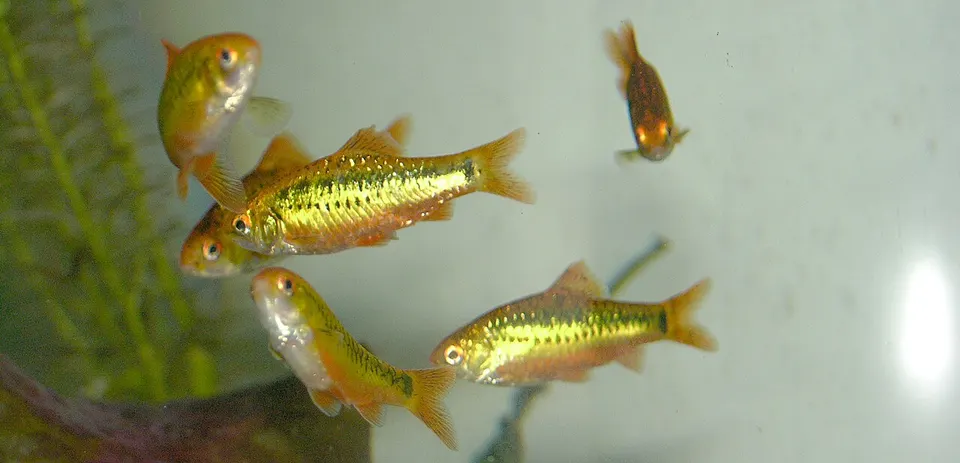
The Gold Barb is a beautiful, hardy fish that has been a staple in the aquarium hobby for decades. The golden-yellow coloration is actually a captive-bred color morph; wild specimens (known as Chinese Barbs) are green. Their peaceful nature, hardiness, and attractive appearance make them perfect for community aquariums.
Gold Barbs are one of the most peaceful barb species, rarely showing the fin-nipping tendencies of some of their relatives. They're excellent choices for beginners and work well in subtropical setups that don't require heaters.
Gold barbs are the yellow captive form of Barbodes semifasciolatus, a fish whose wild type is green and whose home water is in China, Taiwan, and Vietnam. Adults reach about 2.5 to 3 inches and live 5 to 7 years. They want a cool 64 to 75°F, pH 6.0 to 8.0, hardness 5 to 19 dGH, and a tank of at least 20 gallons. They are peaceful schooling omnivores. The gold color is a morph. A green fish in the same tank is not a different species. It is the original one, sometimes sold as a Chinese barb or a half-banded barb.
The temperature is the fact that gets missed. A heater locked at 80°F for a tropical community sits above this card. Gold barbs do well in an unheated room that stays in the upper 60s and low 70s, and they fade and shorten their lives when they are kept hot. They are not a coldwater pond fish in the goldfish sense, and they are not a discus companion. The middle of their range, around 70°F, with clean water and a school, is where the color holds.
Gold Barb sustained welfare comes from parameter discipline, measured nutrition, and proper quarantine — not from ad-hoc intervention; these factors drive outcomes more than brand-name products.
Natural Habitat
The wild form originates from East Asian waters.
- Range: Southern China, Taiwan, northern Vietnam
- Environment: Slow-moving streams, rivers, and ponds
- Climate: Subtropical; tolerates seasonal temperature changes
- Habitat: Vegetated areas with various substrates
Varieties
Several forms are available.
- Gold Barb: Classic golden-yellow captive-bred variety
- Chinese Barb (Green Barb): Wild-type greenish coloration
- Albino Gold Barb: Lighter coloration with pink eyes
- Neon Gold Barb: Enhanced coloration through selective breeding
Tank Requirements
Gold Barbs are adaptable and easy to house: Your aquatic veterinarian and experienced Gold Barb owners can offer perspective tailored to your situation.
- Tank Size: Minimum 20 gallons for a school of 6
- Swimming Space: Appreciate open swimming areas
- Plants: Enjoy planted tanks; won't damage most plants
- Substrate: Any; sand, gravel, or planted substrates
- Filtration: Moderate; gentle to moderate current
- Decorations: Appreciate driftwood and rock formations
Water Parameters
Gold Barbs are very adaptable: The habits that keep a Gold Barb healthy long-term almost always start with an owner willing to learn.
| Parameter | Ideal Range |
|---|---|
| Temperature | 64-75°F (18-24°C) |
| pH | 6.0-8.0 |
| Hardness (GH) | 5-19 dGH |
| Ammonia | 0 ppm |
| Nitrite | 0 ppm |
| Nitrate | <30 ppm |
Diet & Feeding
Gold Barbs are unfussy omnivores: Every time you adjust for something the Gold Barb actually does, rather than what breed profiles predict, results improve.
- Staple Food: Quality flake or small pellet food
- Protein: Bloodworms, brine shrimp, daphnia
- Vegetables: Blanched spinach, peas, cucumber
- Algae: Will graze on algae naturally
- Variety: Varied diet enhances coloration
Feeding Schedule: Feed 2 times daily; what they consume in 2-3 minutes.
Behavior & Social Structure
Gold Barbs are peaceful and social: Gold Barb-aware routines catch issues earlier, respond faster, and prevent more than generic ones.
- Schooling: Keep in groups of 6+ for best behavior
- Peaceful: One of the most peaceful barb species
- Active: Moderately active swimmers
- No Fin Nipping: Rarely nip fins unlike some barbs
- Mid-Level: Primarily swim in middle water column
Keep six or more. A pair of gold barbs in a 20-gallon tank is a shy pair. A school uses the whole length, and the males show a bit of red in the fins when they are displaying at females rather than fighting out of boredom. They are one of the barbs that can live with peaceful tankmates. Long-finned slow fish are still a risk if the school is too small. Give them plants and open swimming room, and keep the group large enough that the display stays inside the school.
Feed a flake or small pellet, a vegetable flake, and frozen daphnia or brine shrimp. They are unfussy omnivores and they will also pick at soft growth. They are not an algae crew. Nitrate under 30 ppm is the ceiling here, and a 20-gallon tank with a school and a couple of other fish reaches it if the filter is a token. Five to 7 years is a solid life for a barb and it depends on the cool water more than on any special food. A gold barb in a hot, bare tank goes pale and looks like a different, cheaper fish.
Buy the school you intend to keep. Adding one new gold barb to a settled group works worse than buying them together. The wild-type green fish can join the gold ones. They will school together because they are the same species. A tiger barb should not. Different genus, different temper, and a fin-nipper besides. If the shop labeled every yellow fish a gold barb, check the markings. A rosy barb is larger, redder, and not this animal. Schubert's barb, the old trade name, is this one.
Compatibility
Gold Barbs are excellent community fish.
Compatible Tank Mates
- Other peaceful barbs (Rosy Barbs, Cherry Barbs)
- White Cloud Mountain Minnows
- Danios and rasboras
- Corydoras catfish
- Loaches
- Peaceful tetras
- Dwarf gouramis
Incompatible Species
- Large aggressive fish
- Very small species that may be intimidated
- Slow-moving long-finned fish (may occasionally nip)
- Tropical fish requiring high temperatures
Breeding
Gold Barbs are relatively easy to breed.
- Sexing: Males slimmer and more colorful; females plumper
- Conditioning: Feed high-quality foods; slight temperature increase
- Spawning: Scatter eggs among fine-leaved plants
- Eggs: 150-400 eggs per spawn; hatch in 24-48 hours
- Parents: Will eat eggs; remove after spawning
- Fry Care: Feed infusoria, then baby brine shrimp
Common Health Issues
Gold Barbs are very hardy but can experience: Your aquatic veterinarian and experienced Gold Barb owners can offer perspective tailored to your situation.
- Ich: Common parasite; easily treated
- Fin Rot: Usually from poor water quality
- Color Fading: Often from stress or poor diet
- Bloat: From overfeeding
- Temperature Stress: Avoid temperatures above 78°F
Health & Care Products
Chewy - Quality foods | Petco - Water test kits | 1-800-PetMeds - Fish medications
Is This Fish Right for You?
People often underestimate how much this piece of a Gold Barb's routine influences later health outcomes.
Gold Barbs Are Great For:
- Beginners to fishkeeping
- Subtropical/unheated aquariums
- Peaceful community setups
- Those wanting hardy, attractive fish
Gold Barbs May Not Be Ideal For:
- Very small aquariums (under 20 gallons)
- Heated tropical tanks (above 78°F)
- Tanks with very small or delicate fish
- Those wanting only 1-2 fish
Before committing to a Gold Barb, think less about whether this species is "easy" or "hard" and more about whether your setup matches its specific needs. A species rated as easy can still fail in the wrong environment.
Gold barbs are a schooling fish. Keep six or more, or the group gets small and they nip fins, including their own tankmates. A single gold barb as a centerpiece will not behave like the fish in the shop photo. They jump, so cover the tank. They are a poor mix with bettas and long fancy fins. Give them swimming room, plants, and a filter that can handle a busy midwater school. The gold color is common in the trade. The species still needs a group, clean water, and a lid. A lone barb in a bowl is the mistake.
Cost of Ownership
Keep in mind that Gold Barb expenses can fluctuate based on your location, individual health needs, and the level of care you choose.
Related Species
If you're interested in Gold Barbs, you might also consider.
- Rosy Barb - Larger, equally hardy barb
- White Cloud Mountain Minnow - Similar temperature needs
- Endler's Livebearer - Colorful small fish
- Pencilfish - Peaceful alternative
Ask Our AI About Gold Barbs
Have specific questions about Gold Barb care, tank mates, or breeding? Our AI assistant can provide personalized guidance.
When to Seek Help
- Water testing: Before treating for disease, always test water parameters.
Diet and Nutrition Tips
- Primary diet: Feed a high-quality staple food formulated for your Gold Barb's dietary type (herbivore, omnivore, or carnivore). Look for foods with whole ingredients and minimal fillers.
- Variety ensures complete nutrition and encourages natural foraging.
- Feeding frequency: Feed small amounts 1-2 times daily.
- Avoid overfeeding: Overfeeding is the most common nutritional mistake in fishkeeping. It leads to obesity, water pollution, and secondary health problems.
Tank Environment and Stimulation
- Tank size: Always choose a tank that meets or exceeds the minimum recommended size for Gold Barb. Larger tanks are more stable and forgiving of water quality fluctuations.
- Water parameters: Maintain consistent temperature, pH, and hardness levels appropriate for Gold Barb. Test water weekly and perform regular partial water changes.
- Filtration: Use a quality filter rated for your tank size.
- This reduces stress and aggression.
Tank Maintenance Essentials
- Water changes: Perform 20-30% partial water changes weekly.
- Filter maintenance: Rinse filter media in old tank water monthly.
- Algae control: Some algae is normal, but excessive growth indicates nutrient imbalance. Adjust lighting duration and consider adding algae-eating species.
- Water testing: Test ammonia, nitrite, nitrate, and pH at least weekly. Keep a log to track trends and catch problems early.
Living Environment
- A stable location reduces stress and prevents temperature fluctuations.
- Compatible tankmates: Research compatibility before adding new species. Aggression, different water parameter requirements, and size mismatches are common problems.
- Substrate choice: Select substrate appropriate for your Gold Barb's natural behavior, whether that is sand for digging species or planted substrate for aquascaping.
- Equipment failures can be life-threatening.
Helpful Resources for Gold Barb Owners
The habits that keep a Gold Barb healthy long-term almost always start with an owner willing to learn.
Explore More Guides
Get Personalized AI Guidance
Ask Our AI NowDecision Guides for Gold Barb
Use these only when comparing food, insurance, ownership budget, or beginner fit for this specific pet.
Gold barbs are active schooling fish that stay around 3 inches and do best in a group of six with room to swim. They eat flake and frozen foods and will sample plants. A single gold barb harasses other fish. Keep a lid on, and give them a long tank of 20 gallons or more, with a lid. A tall nano cube gives them almost no swimming length.