Peruvian Guinea Pig
This page is educational reference material for preparing questions. A licensed veterinarian examines the animal, makes the diagnosis, and sets the treatment.
Affiliate links may earn a commission. Affiliate disclosure.
Quick Facts
| Attribute | Details |
|---|---|
| Scientific Name | Cavia porcellus |
| Origin | South America (selective breeding) |
| Size | Medium (1.5-3 lbs / 0.7-1.4 kg) |
| Lifespan | 5-7 years |
| Diet | Herbivore (hay, vegetables, pellets, vitamin C) |
| Activity Level | Moderate |
| Social Needs | Very High - need companions |
| Care Level | Advanced (high grooming needs) |
| Space Requirements | Minimum 7.5 sq ft for one, 10.5 sq ft for two |
Recommended for Peruvian Guinea Pigs
Oxbow - Vitamin C fortified nutrition | Kaytee - Grooming tools and supplies | Chewy Autoship - Save 35% on supplies
Peruvian Guinea Pig Overview
The Peruvian Guinea Pig is the oldest recognized long-haired guinea pig breed and is renowned for its stunning, floor-length coat that can grow up to 20 inches long. Show-quality Peruvians have hair that parts naturally along the spine and flows down both sides, often completely obscuring their face and body.
This breed requires significant daily grooming commitment, making it better suited for experienced guinea pig owners or those prepared for the maintenance required. Despite the grooming needs, Peruvians are beloved for their dramatic appearance and typically sweet personalities.
The Peruvian guinea pig is a long-haired Cavia porcellus whose coat falls forward over the face. That direction is the breed. A silkie, also called a sheltie, grows long hair that sweeps back off the face. They are not the same haircut, and they are not interchangeable because both look fluffy in a photograph. Origin on the card is South America by selective breeding. Size is medium, 1.5-3 lbs, or 0.7-1.4 kg. Lifespan is 5-7 years. The hair over the eyes is the daily problem inside that lifespan.
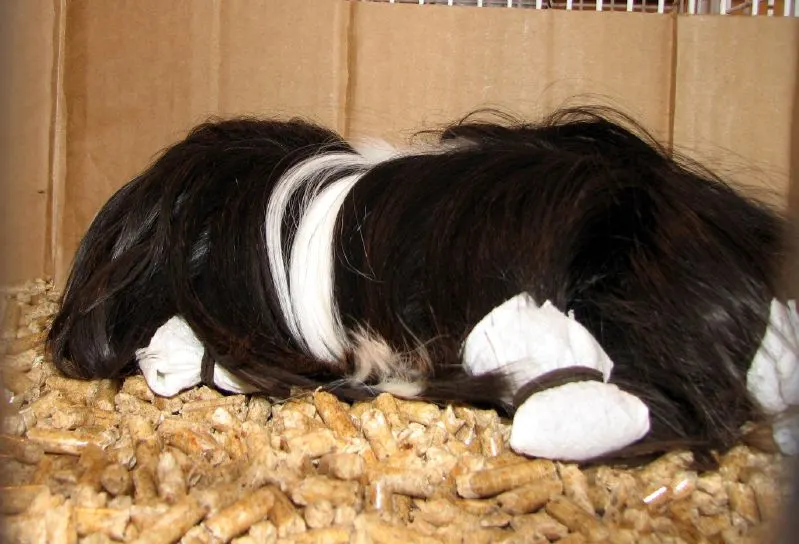
The coat needs care every day. If it is missed, it mats, and it covers the eyes. A Peruvian that cannot see its food will stop moving around the pen and will look dull for a reason that is mechanical, not mysterious. Show animals are often kept in wraps so the hair stays clean and out of the way until it is let down. A pet at home does not have to live in wraps, but then someone has to comb the hair, keep it off the face, and deal with mats before they tighten against the skin. Bathing a matted coat without combing it first makes felt. Care level is advanced because of that grooming, not because the animal is fierce.
When a Peruvian Guinea Pig's diet shifts in any meaningful way, a pre-emptive note to the exotic veterinarian is a cheap safety net.
Coat Characteristics
Understanding the Peruvian's magnificent coat.
Coat Features
- Length: Can grow up to 20 inches (50 cm) on show animals
- Growth Pattern: Hair grows forward from two rosettes on the rear
- Part: Natural center part along the spine
- Texture: Long, straight, silky, and smooth
- Forelock: Long hair covers the face completely
- Colors: All guinea pig colors and patterns available
Pet vs Show Coat
- Show Peruvians: Coat grown to full length, requires wrapping
- Pet Peruvians: Often kept trimmed to 3-4 inches for comfort
- Baby Coat: Young Peruvians have shorter coats that grow with age
Housing Requirements
Peruvians need housing that protects their coat.
Enclosure Size
- One Guinea Pig: Minimum 7.5 square feet
- Two Guinea Pigs: Minimum 10.5 square feet
- Important: Larger cages keep coat cleaner
Special Enclosure Considerations
- Bedding: Fleece liners preferred - less debris tangles in coat
- Avoid: Wood shavings and hay bedding that stick to long hair
- Hay Area: Separate hay feeding area to minimize coat contamination
- Water: Bowls may wet the coat; consider sipper bottles
- Cleanliness: More frequent spot-cleaning needed
- Hide Houses: Smooth-sided to avoid catching hair
Grooming Commitment Required
Peruvian Guinea Pigs require DAILY grooming - this is non-negotiable. Neglected coats quickly become matted, causing skin issues, restricted movement, and hygiene problems. If daily grooming isn't possible, consider keeping the coat trimmed short or choosing a short-haired breed instead.
Grooming Requirements
Grooming is the most significant aspect of Peruvian care: The habits that keep a Peruvian Guinea Pig healthy long-term almost always start with an owner willing to learn.
Daily Grooming
- Brushing: Daily brushing is essential - twice daily for full-length coats
- Tools: Wide-tooth comb, soft bristle brush, detangling spray
- Technique: Work from ends up to prevent pulling
- Check for: Debris, tangles, mats, and soiling
- Sanitary Trim: Keep hair short around rear for hygiene
Coat Maintenance Options
- Full Length: Requires wrapping in protective papers/tissue
- Pet Trim: Trimmed to 3-4 inches - much more manageable
- Face Trim: Keep hair trimmed away from eyes for comfort
- Professional Grooming: Consider monthly professional trims
Bathing
- More frequent bathing than short-haired breeds (monthly or as needed)
- Use guinea pig-safe shampoo
- Dry thoroughly to prevent chilling
- Blow-dry on low, cool setting if pig tolerates it
- Brush out completely after drying
Diet & Nutrition
Same nutritional needs as all guinea pigs: Your exotic veterinarian and experienced Peruvian Guinea Pig owners can offer perspective tailored to your situation.
Daily Diet Components
- Hay (80%): Unlimited timothy hay - serve in a rack to keep coat clean
- Fresh Vegetables (15%): 1 cup daily of vitamin C-rich vegetables
- Pellets (5%): 1/8 cup vitamin C-fortified pellets
- Vitamin C: 10-30mg daily essential
- Water: Fresh water always available
Coat Health Nutrition
- Quality nutrition supports healthy coat growth
- Adequate protein for fur production
- Omega fatty acids for coat shine
- Vitamin C for overall health including skin
The diet is an herbivore diet: hay, vegetables, pellets, and vitamin C. The long hair does not change the vitamin C requirement. Guinea pigs do not make their own, and a Peruvian on hay alone with no vitamin C source will decline the same way a short-haired cavy does. Hay still has to be available all the time. Pellets made for guinea pigs, plus vegetables, are how most homes cover the vitamin C without turning the bowl into fruit. A coat full of sticky fruit juice is a mat waiting to happen. Activity is moderate. They will not exercise their way out of a coat that blinds them.
Learning to read a pet food label takes five minutes and will serve you for the life of your Peruvian Guinea Pig. Look at the guaranteed analysis for protein and fat percentages that match your Peruvian Guinea Pig's needs.
Common Health Issues
Peruvians share health concerns with all guinea pigs plus coat-related issues.
Coat-Related Problems
- Matting: Causes skin irritation, restricted movement, pain
- Skin Issues: Hidden under coat - check skin during grooming
- Parasites: Mites and lice harder to detect in long coat
- Hygiene Issues: Soiling if coat not kept clean around rear
- Heat Stress: Long coat makes temperature regulation harder
General Health Concerns
- Vitamin C Deficiency: Critical to prevent through diet
- Respiratory Issues: Watch for sneezing, discharge
- Dental Problems: Unlimited hay prevents overgrown teeth
- Bladder Stones: Watch for blood in urine, straining
Preventive care for a Peruvian Guinea Pig is not just about annual exams — it is a mindset. That partnership between attentive ownership and professional guidance is what keeps most Peruvian Guinea Pigs in good shape throughout their lives.
Understanding your Peruvian Guinea Pig's genetic makeup can guide decisions about everything from exercise intensity to supplement choices. It is one of the more practical tools available for anyone committed to keeping their Peruvian Guinea Pig in the best possible shape.
Planning for your Peruvian Guinea Pig's senior phase begins well before the grey appears. Peruvian Guinea Pigs that receive thoughtful, consistent care through this transition tend to maintain vitality and comfort far longer than those whose care remains static.
Handling & Socialization
Peruvians are typically gentle and tolerant.
Handling Tips
- Support the body and be careful not to pull on coat
- Many become accustomed to grooming sessions
- Regular handling makes grooming easier
- Trim face hair so they can see you approaching
- Most are docile due to frequent handling for grooming
Temperament
- Calm: Generally laid-back personalities
- Social: Need companionship like all guinea pigs
- Patient: Often tolerate handling well
- Alert: Still curious and interactive
Behavior & Temperament
Peruvians have typical guinea pig behaviors: Your exotic veterinarian and experienced Peruvian Guinea Pig owners can offer perspective tailored to your situation.
Common Behaviors
- Wheeking: Excited squealing, especially for food
- Purring: Contentment when petted
- Popcorning: May be less acrobatic due to coat weight
- Grooming: Self-grooming and grooming companions
Activity Level
- Generally moderate energy
- Long coat may restrict some movement
- Still need exercise time and enrichment
- May prefer shorter activity sessions
Social needs are very high. They need companions. Space is a minimum of 7.5 sq ft for one and 10.5 sq ft for two. A Peruvian in a small pet-store cage, alone, with hair in its eyes, is outside every line on this card at once. Two animals need the 10.5 sq ft, and they need the grooming done on both, because a cagemate will not comb a Peruvian's face. Five to 7 years, the 5-7 year lifespan, is a long time to keep hair that grows toward the eyes. Advanced care is the comb, the vitamin C, the hay, and enough floor. It is not the care sheet for a silkie, whose hair sweeps the other way.
Peruvians Are Great For:
- Experienced guinea pig owners ready for advanced care
- Those who enjoy grooming as a bonding activity
- Show enthusiasts willing to maintain full coats
- People with time for daily grooming commitment
- Those who appreciate dramatic, beautiful pets
Peruvians May Not Be Ideal For:
- First-time guinea pig owners
- Busy people without time for daily grooming
- Children as primary caretakers
- Those on a tight budget (grooming tools, potential professional grooming)
- Anyone not willing to trim coat if needed for welfare
Owning a Peruvian Guinea Pig is a commitment measured in years, not months. If it sounds exhausting, it is worth reconsidering.
Peruvian Guinea Pig ownership is, at its core, a relationship. Everything else — grooming, veterinary care, training — is infrastructure. What you actually get in return is an animal that knows you, relaxes around you, and becomes woven into household life. Most Peruvian Guinea Pig owners say that piece is what carries the rest.
Cost of Ownership
These Peruvian Guinea Pig cost estimates give you a solid starting point, but real-world expenses vary by location, health status, and personal choices. Building in some buffer for unplanned expenses is always a good idea.
These cost ranges reflect typical spending, but every Peruvian Guinea Pig is different. Use these numbers as a planning baseline, not a guarantee.
Year one hits the wallet hardest. Once those one-time costs are behind you, annual spending drops — though it tends to creep back up as your Peruvian Guinea Pig ages and needs more frequent veterinary attention in the later years.
Preventive care is not glamorous, but it is the single best investment you can make in your Peruvian Guinea Pig's health. Routine wellness exams catch problems early, when treatment is simpler and cheaper. Most veterinary professionals agree that consistent preventive care extends both the length and quality of a Peruvian Guinea Pig's life.
Related Species to Consider
If you're interested in Peruvian Guinea Pigs, you might also consider.
- American Guinea Pig - Smooth coat, minimal grooming
- Abyssinian Guinea Pig - Rosette coat, moderate grooming
- Teddy Guinea Pig - Plush coat, easier maintenance
- Lionhead Rabbit - If you enjoy grooming long-haired small pets
Ask Our AI About Peruvian Guinea Pigs
Have specific questions about Peruvian Guinea Pig grooming, care, or health? Our AI assistant can provide personalized guidance.
Get Personalized AI Guidance
Ask Our AI NowDecision Guides for Peruvian Guinea Pig
Use these only when comparing food, insurance, ownership budget, or beginner fit for this specific pet.