Rainbowfish
This page is educational reference material for preparing questions. A licensed veterinarian examines the animal, makes the diagnosis, and sets the treatment.
Affiliate links may earn a commission. Affiliate disclosure.
Quick Facts
| Attribute | Details |
|---|---|
| Type | Freshwater |
| Size | Medium (4-6 in) |
| Lifespan | 5-8 years |
| Temperature | 72-82°F |
| pH Range | 6.5-8.0 |
| Min Tank Size | 30 gal |
| Care Level | Beginner |
| Diet | Omnivore |
| Temperament | Peaceful |
Recommended for Rainbowfish
Quarantine new rainbowfish. Shops often sell them thin, and velvet and ich show up after the move. Feed them in the quarantine tank until the school is eating and no fish is clamped. Then move the group together. Adding them one a month keeps the newest fish as the target.
Rainbowfish Overview
The Rainbowfish is a medium (4-6 in) freshwater species that is an excellent choice for both beginners and experienced aquarists. With a lifespan of 5-8 years, this peaceful species requires a minimum tank size of 30 gal.
Rainbowfish thrive in water temperatures of 72-82°F with a pH range of 6.5-8.0. As an omnivore, they accept a wide variety of foods.
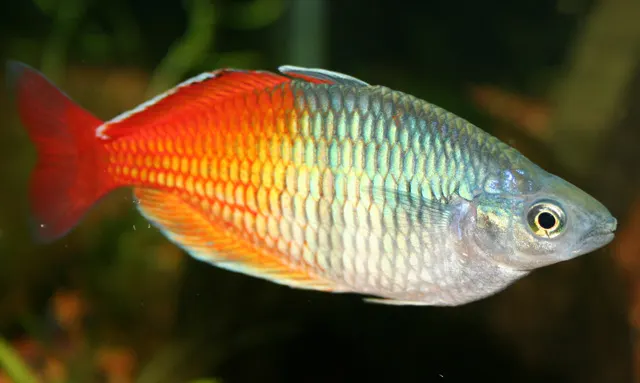
Rainbowfish are schooling Australian and New Guinean fish. This page's size class is a medium fish about 4-6 inches, with a lifespan of about 5-8 years. Boesemani, Parkinson, and many Melanotaenia stay in that range. A threadfin or a large Glossolepis does not. Males color up when they can display to other males. A lone rainbowfish looks nothing like the photograph. A lifespan of 5-8 years assumes the school stays together and the tank stays covered.
They are fast, peaceful with fish too big to eat, and rough on very small shrimp and on long fins if the school is under six. Give them length to swim. They spawn in plants continuously, and the adults eat the eggs. A school of six in a 30-gallon tank is the start this page describes, not the end, if you chose a 5-inch species.
Keep them at 72-82°F and pH 6.5-8.0, with a minimum of 30 gallons for a small school of a medium species. They are omnivores: a staple flake or small pellet, plus frozen bloodworms or brine, and some plant matter. They jump. Cover the tank. Do not trust a single temperature number for every rainbowfish sold under this name. A Celebes rainbowfish wants it warmer than a cool-water species. Read the label for the scientific name. The minimum 30 gallons on this page is a school of a smaller species, not one fish in a bowl.
Tank Requirements & Setup
Buy the school in one visit from one healthy tank. Six pale juveniles that eat are a better start than two fully colored males that fight. Color comes after they settle and can see each other.
Tank Size
- Minimum: 30 gal
- Recommended: Larger is always better for stability and swimming room.
- Type: Freshwater planted or community tank
Equipment
- Filtration: Quality canister or HOB filter rated for your tank size.
- Heating: Reliable heater to maintain 72-82°F.
- Lighting: Standard aquarium lighting; planted tanks benefit from full-spectrum.
- Air Pump: Optional but beneficial for oxygenation.
Water Parameters
| Parameter | Ideal Range |
|---|---|
| Temperature | 72-82°F |
| pH | 6.5-8.0 |
| Ammonia | 0 ppm |
| Nitrite | 0 ppm |
| Nitrate | <20 ppm |
Water Quality Warning
Always cycle your tank fully before adding fish. Use a quality test kit to monitor ammonia, nitrite, and nitrate levels. Never add Rainbowfish to an uncycled or newly set up tank.
Diet & Feeding
- Primary Diet: Omnivore.
- Foods: High-quality flakes/pellets, frozen brine shrimp, mysis shrimp, and blanched vegetables.
- Variety: Rotate different food types for balanced nutrition.
Rainbowfish Tank Essentials
API Master Test Kit - Monitor water quality | Seachem Prime - Water conditioner | Aquarium Co-Op - Premium fish foods
Proper nutrition for Rainbowfish requires understanding not just what to feed, but how feeding strategies affect health, behavior, and water quality. A disciplined approach to feeding, where your Rainbowfish receives the right amount of appropriate food at consistent intervals, is one of the most impactful things you can do for both the fish and the overall aquarium ecosystem.
Diet variety is essential for optimal Rainbowfish health because no single commercial food provides the complete nutritional profile these fish require. Observing your Rainbowfish's response to different food types also provides useful health information, as reduced interest in normally preferred foods is often an early indicator of illness.
Common Health Issues
- Ich (White Spot Disease): White spots on body and fins. Raise temperature gradually and use ich medication.
- Parasites: Internal and external parasites; quarantine new additions.
The foundation of Rainbow Fish health management is water quality — full stop. Regular testing and diligent maintenance are your best tools.
Recognizing early signs of disease in Rainbowfish requires a trained eye and consistent observation. Establishing a daily observation routine—even just a few minutes of focused attention during feeding—helps you develop a baseline understanding of what normal behavior looks like for your specific Rainbowfish, making deviations immediately apparent.
Quarantine protocols represent one of the most impactful health management practices available to Rainbowfish keepers. This single practice prevents the majority of disease outbreaks in established aquariums and is considered essential by virtually all experienced Rainbowfish keepers.
Compatibility
- Temperament: Peaceful - pairs well with other peaceful community species.
- Tank Mates: Other peaceful community fish of similar size.
- Avoid: Large aggressive species that may bully or eat them.
Is This Species Right for You?
Time spent understanding this topic is one of the highest-leverage investments a Rainbow Fish owner can make. Some iteration is normal, a Rainbow Fish tends to signal clearly when something fits and when it does not.
Rainbowfish Are Great For:
- Beginning aquarists looking for a rewarding species
- Community freshwater tank keepers
- Those who can maintain stable freshwater parameters
Rainbowfish May Not Be Ideal For:
- Those unable to commit to regular water testing and maintenance
- Those looking for a zero-maintenance pet
Ask Our AI About Rainbowfish
Have specific questions about Rainbowfish care, tank setup, or health? Our AI assistant can provide personalized guidance.
Adding a Rainbowfish to your setup works best when you have honestly evaluated your tank size, maintenance habits, and budget.
Experienced Rainbowfish keepers will tell you that the learning curve is steepest in the first few months. After that, maintenance becomes routine.
When to Seek Help
Recognizing signs of illness early gives your Rainbowfish the best chance of recovery.
- Water testing: Before treating for disease, always test water parameters.
Diet and Nutrition Tips
Proper nutrition is the foundation of good health for your Rainbowfish.
- Primary diet: Feed a high-quality staple food formulated for your Rainbowfish's dietary type (herbivore, omnivore, or carnivore). Look for foods with whole ingredients and minimal fillers.
- Variety ensures complete nutrition and encourages natural foraging.
- Feeding frequency: Feed small amounts 1-2 times daily.
- Avoid overfeeding: Overfeeding is the most common nutritional mistake in fishkeeping. It leads to obesity, water pollution, and secondary health problems.
Tank Environment and Stimulation
Providing the right environment is crucial for your Rainbowfish's health and well-being.
- Tank size: Always choose a tank that meets or exceeds the minimum recommended size for Rainbowfish. Larger tanks are more stable and forgiving of water quality fluctuations.
- Water parameters: Maintain consistent temperature, pH, and hardness levels appropriate for Rainbowfish. Test water weekly and perform regular partial water changes.
- Filtration: Use a quality filter rated for your tank size.
- This reduces stress and aggression.
Tank Maintenance Essentials
- Water changes: Perform 20-30% partial water changes weekly.
- Filter maintenance: Rinse filter media in old tank water monthly.
- Algae control: Some algae is normal, but excessive growth indicates nutrient imbalance. Adjust lighting duration and consider adding algae-eating species.
- Water testing: Test ammonia, nitrite, nitrate, and pH at least weekly. Keep a log to track trends and catch problems early.
Living Environment
Creating the optimal living environment ensures your Rainbowfish thrives and displays natural, healthy behaviors.
- A stable location reduces stress and prevents temperature fluctuations.
- Compatible tankmates: Research compatibility before adding new species. Aggression, different water parameter requirements, and size mismatches are common problems.
- Substrate choice: Select substrate appropriate for your Rainbowfish's natural behavior, whether that is sand for digging species or planted substrate for aquascaping.
- Equipment failures can be life-threatening.
Helpful Resources for Rainbowfish Owners
Explore More Guides
Get Personalized AI Guidance
Ask Our AI NowDecision Guides for Rainbowfish
Use these only when comparing food, insurance, ownership budget, or beginner fit for this specific pet.
Behavior & Temperament
Rainbowfish are characterized by a peaceful disposition that influences their care requirements and compatibility.
- General Disposition: Peaceful nature that defines daily interactions
- Social Behavior: Specific social needs that owners should understand and accommodate
- Activity Patterns: Natural activity cycles that influence care scheduling
Rainbowfish on this card are medium schooling fish, 4 to 6 inches, with a lifespan of 5 to 8 years. A school of fish this size needs at least 30 gallons. They are peaceful omnivores rated at beginner level, and the color people buy them for shows up in males as they mature, not in the silver juveniles lined up at the shop. Most of the fish sold under this name are Melanotaenia and the closely related New Guinea genera. The card does not split those species, so the numbers below are the shared envelope: 72 to 82°F, pH 6.5 to 8.0, nitrate under 20 ppm, ammonia 0 ppm, nitrite 0 ppm.
A 30-gallon tank is the listed floor for fish that reach 6 inches and need a group. Use the length. A tall tank of that volume with a short footprint turns a school into a pile of fish treading at the glass. Several males with females, in a planted tank that still has an open lane, color up more reliably than a single male kept alone to be the centerpiece. They are not aggressive community fish, and they are too fast and too boisterous for a long-finned betta in a small box.
Feed them as omnivores with a bias toward foods that support color. A quality flake, frozen mysis or brine shrimp, and some vegetable matter cover the diet line. They feed at the surface and in the middle, and they will outcompete shy bottom fish if you only sprinkle food at the top. Beginner care assumes the tank is already stable. A 4-inch rainbowfish is not a cycling tool, and nitrate that lives above 20 ppm fades the same colors the fish was bought for.
Different species inside the hobby name get larger or smaller than the 4-to-6-inch band, so a fish identified only as a rainbow should be stocked as if it will reach the top of that range. Boesemani types are the usual large, late-coloring fish in this slot. They spend their first months looking plain. Selling them on or crowding them because the color never came is a timing problem. Give the school a year in clean water inside the pH and temperature bands before you decide the strain is dull.
They jump when they are startled, especially in a sparsely planted tank with a gap at the back of the lid. Put a lid on before the first scare sends one over the rim. Keep the school together when you buy them so you are not adding one nervous fish to a tank that already has a hierarchy. The 5-to-8-year lifespan fits a group that was given 30 gallons or more of length, ordinary omnivore food, and nitrate held under 20 ppm. It does not fit a single juvenile in an uncycled desktop aquarium.
Feeding behavior in Rainbowfish reveals much about their ecological role and can be leveraged by keepers to promote natural behaviors and reduce aggression. Observing when, where, and how your Rainbowfish feeds provides diagnostic information about their comfort level, health status, and social standing. Changes in feeding behavior—such as reduced enthusiasm, feeding only when other fish are not present, or aggressive food guarding—often signal underlying issues that should be investigated. Many successful Rainbowfish keepers use varied feeding strategies including target feeding, scatter feeding, and enrichment feeders to promote natural foraging behaviors and reduce competition-related stress.
Cost of Ownership
These figures are averages, not guarantees. Some Rainbowfish owners spend less; others spend more due to health complications or premium product preferences. Where you live matters too — urban vet costs tend to run higher. The point is to go in with a realistic financial picture, not an optimistic one.
Price a long tank of at least 30 gallons, a lid, a heater, and six fish, not one fish and a bowl. Frozen food and a quarantine tub are the ongoing cost. Replacing jumpers that dried behind the stand is the expensive surprise. Minimum 30 gallons is the floor for a small school of a 4-6 inch species, and a larger male Boesemani school wants more length than a 30-gallon box provides. Price the minimum 30 gallons as a floor, then add length if the species is a 5-inch Melanotaenia.
Equipment failure is an inevitable aspect of aquarium keeping that should be factored into financial planning. Heaters, filters, lights, and pumps all have finite lifespans, and their failure—particularly heater or filter failure—can have catastrophic consequences for Rainbowfish if not addressed promptly. Maintaining a small emergency fund specifically for aquarium equipment replacement, or keeping backup equipment on hand for critical systems like heating and filtration, is a wise investment. Many experienced Rainbowfish keepers also invest in battery-operated air pumps and backup heaters as insurance against power outages, which can be lethal to tropical species within hours depending on ambient room temperature.
The cost-benefit analysis of quality versus budget equipment deserves careful consideration for Rainbowfish keepers. Higher-quality filters, heaters with accurate thermostats, and reliable lighting systems cost more upfront but typically last longer, perform more consistently, and are less likely to fail catastrophically. In aquarium keeping, equipment failure can result in livestock losses worth far more than the savings from choosing budget equipment. This is particularly true for Rainbowfish, where the animals themselves, along with any tank mates, plants, and established biological filtration, represent a significant investment of both money and time that is worth protecting with reliable equipment.
Rainbowfish are active swimmers from New Guinea and Australia. A school of six or more needs a long tank of 30 gallons or more, a lid, and flake plus frozen foods. Males color up as they settle. They are too fast and too large at adult size for a 10-gallon betta tank.