Flowerhorn Cichlid
This page is educational reference material for preparing questions. A licensed veterinarian examines the animal, makes the diagnosis, and sets the treatment.
Affiliate links may earn a commission. Affiliate disclosure.
Quick Facts
| Attribute | Details |
|---|---|
| Scientific Name | Hybrid (no scientific name) |
| Origin | Malaysia/Taiwan (man-made hybrid) |
| Size | 10-16 inches (25-40 cm) |
| Lifespan | 10-12 years |
| Temperature | 80-86°F (27-30°C) |
| pH | 7.0-8.0 |
| Tank Size | 75+ gallons minimum |
| Care Level | Intermediate |
| Diet | Carnivore/Omnivore |
| Temperament | Highly Aggressive |
Recommended for Flowerhorn Cichlids
Chewy - Premium cichlid foods & color enhancers | Petco - Large tanks & powerful filtration | PetSmart - Heaters & water treatments
Overview
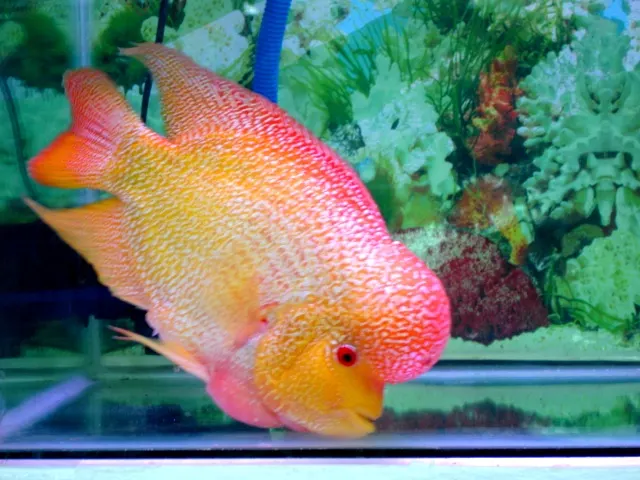
The Flowerhorn Cichlid is a man-made hybrid fish developed in Malaysia and Taiwan during the late 1990s. Created by crossing various Central and South American cichlids, Flowerhorns are prized for their vivid colors, distinctive nuchal hump (kok), and interactive personalities.
These fish are considered symbols of good luck and prosperity in Asian cultures, with specimens featuring prominent humps and bright "pearls" (iridescent markings) commanding premium prices. Flowerhorns are truly "wet pets" that recognize their owners and can be trained to respond to hand signals.
Flowerhorns are man-made hybrids, produced in Malaysia and Taiwan, with no scientific species name. They are not a wild fish from a lake. Adults reach 10 to 16 inches and live 10 to 12 years. An adult belongs in 75 gallons or more. They want 80 to 86°F, pH 7.0 to 8.0, and hardness around 8 to 15 dGH. They eat meat and prepared cichlid foods. Temperament is highly aggressive. Care is intermediate, mostly because the aggression and the waste are predictable. The fish is not a community animal.
The nuchal hump, the kok on the forehead, is a breeding trait that was selected for, not a sign of illness and not a wild-type adaptation to a river. Different lines grow different humps. A hump that suddenly shrinks can mean a stressed or underfed fish. A hump that was never large may simply be the line you bought. Chasing a bigger hump with heavy feedings of one fatty food makes a messy tank and a fish with buoyancy trouble. Feed a cichlid pellet and frozen meaty foods on a schedule the filter can handle.
They produce a heavy bioload. A 75-gallon tank with one flowerhorn still needs filtration sized for a dirtier fish than a single 12-inch body suggests, and nitrate under 20 ppm takes real water changes. Ammonia and nitrite at 0 ppm are the usual line and they slip fast after a big meal. One adult in the tank is the stocking. A pair will fight unless you are set up to breed and to separate them, and even then many keepers never house two adults together. Tetras, plecos, and other cichlids are targets. The peaceful tankmate stories usually end when the flowerhorn is no longer a juvenile.
Natural Habitat
As man-made hybrids, Flowerhorns have no natural habitat: Your aquatic veterinarian and experienced Flowerhorn owners can offer perspective tailored to your situation.
- Origin: Created from crossing multiple cichlid species including Blood Parrot, Trimac, and others
- Development: Selectively bred for color, hump size, and markings
- Varieties: Numerous strains including Kamfa, Zhen Zhu, Golden Monkey, and Red Texas
- Invasive: Released Flowerhorns have become invasive in some tropical regions
Tank Requirements
Flowerhorns require spacious, dedicated setups.
- Tank Size: Minimum 75 gallons for a single fish; 125+ gallons for larger specimens
- Substrate: Bare bottom or sand (easier cleaning)
- Decorations: Minimal; these fish rearrange everything and may injure themselves on sharp objects
- Filtration: Oversized filtration; canister filter rated for 2-3x tank volume
- Heater: Reliable heater maintaining warm temperatures
- Lighting: Good lighting enhances colors; LEDs with color-enhancing spectrum popular
Tank Setup Warning
Flowerhorns are extremely aggressive and should typically be kept alone. They will attack and kill most tank mates, including plecos and other large cichlids.
Water Parameters
Flowerhorns thrive in warm, clean water: Your aquatic veterinarian and experienced Flowerhorn owners can offer perspective tailored to your situation.
| Parameter | Ideal Range |
|---|---|
| Temperature | 80-86°F (27-30°C) |
| pH | 7.0-8.0 |
| Hardness (GH) | 8-15 dGH |
| Ammonia | 0 ppm |
| Nitrite | 0 ppm |
| Nitrate | <20 ppm |
Diet & Feeding
Proper nutrition is crucial for color and hump development.
- Staple Food: High-quality Flowerhorn pellets with color enhancers
- Protein: Shrimp, earthworms, crickets, and market shrimp
- Supplements: Spirulina and astaxanthin for color enhancement
- Avoid: Feeder fish (disease risk), mammal meat, excessive fatty foods
Feeding Schedule: Feed 2-3 times daily in amounts consumed within 2-3 minutes. Some keepers fast one day per week.
Flowerhorn Cichlid sustained welfare comes from parameter discipline, measured nutrition, and proper quarantine — not from ad-hoc intervention; these factors drive outcomes more than brand-name products.
The Nuchal Hump (Kok)
The distinctive forehead hump is a prized feature.
- Genetics: Hump size is primarily determined by genetics
- Development: Begins developing around 4-6 months, peaks at 2-3 years
- Diet Influence: High-quality protein may support hump development
- Gender: Males typically develop larger humps than females
- Fluctuation: Hump size can vary with mood, health, and breeding condition
Behavior & Personality
Flowerhorns are known for their engaging personalities: Your aquatic veterinarian and experienced Flowerhorn owners can offer perspective tailored to your situation.
- Intelligent: Recognize owners and respond to interaction
- Interactive: May follow owners around the room, "beg" for food
- Aggressive: Extremely territorial; will attack hands, nets, and any tank mates
- Trainable: Can learn to respond to hand signals and feeding cues
- Destructive: Rearrange substrate and attack equipment
They recognize the person who feeds them and they will shove gravel around the tank for sport. Décor has to be solid and too big to swallow. They will drag heaters and uproot plants. A bare or sparsely decorated tank with a cave, if you offer one, is easier to keep clean than an aquascape. Intermediate care is the heat, the filter, and the decision to keep the fish alone. It is not a difficult water chemistry problem. pH 7.0 to 8.0 is ordinary hard tap water in a lot of houses. The difficulty is the adult animal.
Ten to 12 years and a body that can pass 16 inches is the purchase. A 2-inch juvenile in a shop tank is a 75-gallon cichlid with a temper. Do not buy it for a community you like. Do not buy two because the colors look good side by side. The hybrid origin also means the exact adult size and the exact temper vary by line, within the range on this card. Budget for the large end of 10 to 16 inches and for a tank that can take the waste of a carnivorous cichlid held at 80 to 86°F.
Compatibility
Flowerhorns are best kept alone.
Housing Considerations
- Solitary: Safest kept as single specimens
- Pairs: Extremely difficult; often results in death of female
- Tank Mates: Rarely successful; even large plecos may be attacked
- Dividers: Some keepers use tank dividers for breeding attempts
Breeding
Breeding Flowerhorns is challenging due to their aggression.
- Fertility: Many Flowerhorns are sterile due to their hybrid nature
- Pairing: Requires dividers that allow visual but not physical contact
- Spawning: Female deposits eggs on flat surface; may need immediate separation
- Fry Variation: Offspring vary greatly in quality and appearance
- Male Aggression: Males often kill females; constant monitoring required
Common Health Issues
Flowerhorns are hardy but susceptible to certain conditions: Your aquatic veterinarian and experienced Flowerhorn owners can offer perspective tailored to your situation.
- Hole in the Head (HITH): Common in cichlids; often from poor water quality or diet
- Ich (White Spot): Treatable with temperature increase and medication
- Bloat: From overfeeding or inappropriate diet
- Fin Damage: Self-inflicted from thrashing against decorations
- Color Fading: Can indicate stress, poor diet, or water quality issues
Health & Enhancement Products
Chewy - Color-enhancing foods & supplements | Petco - Water treatments & test kits | 1-800-PetMeds - Fish medications
For Flowerhorn, prevention is always better than treatment.
Accounting for these specifics from day one saves the corrective rework that shows up when they are discovered later
Is This Fish Right for You?
Flowerhorn ownership includes several low-visibility activities whose compound effect exceeds their individual profile.
Flowerhorns Are Great For:
- Experienced hobbyists wanting a "wet pet"
- Those who appreciate interactive fish
- Keepers with space for a large, dedicated tank
- Aquarists fascinated by unique hybrid fish
Flowerhorns May Not Be Ideal For:
- Beginners to fishkeeping
- Those wanting a community aquarium
- Keepers with limited space or budget
- Anyone uncomfortable with extreme aggression
Aquarium keeping is a hobby of specifics, and Flowerhorn Cichlid is no exception.
If you can commit to the maintenance schedule and the initial investment in proper equipment, a Flowerhorn Cichlid is likely to reward you with an engaging, long-term addition to your aquarium.
Cost of Ownership
Small adjustments based on what you observe often yield the biggest improvements.
Related Species
If you're interested in Flowerhorns, you might also consider.
- Jack Dempsey - Large cichlid with personality
- African Cichlid - Colorful cichlids from Africa
- Arowana - Another impressive "show fish"
- Peacock Bass - Large predatory cichlid
Ask Our AI About Flowerhorn Cichlids
Have specific questions about Flowerhorn care, hump development, or feeding? Our AI assistant can provide personalized guidance.
Get Personalized AI Guidance
Apply accepted best practices, watch what happens, and adjust — deliberate daily practice, not a single breakthrough.
Ask Our AI NowDecision Guides for Flowerhorn Cichlid
Use these only when comparing food, insurance, ownership budget, or beginner fit for this specific pet.
Flowerhorns are man-made Central American cichlid hybrids kept one to a tank. The nuchal hump, the kok, swells when the fish is fed and displayed, and a stressed fish fades it. An adult needs a long tank of 55 gallons or more, a heavy filter, and a pellet made for large cichlids. They rearrange every decoration you add.