Corn Snake
This page is educational reference material for preparing questions. A licensed veterinarian examines the animal, makes the diagnosis, and sets the treatment.
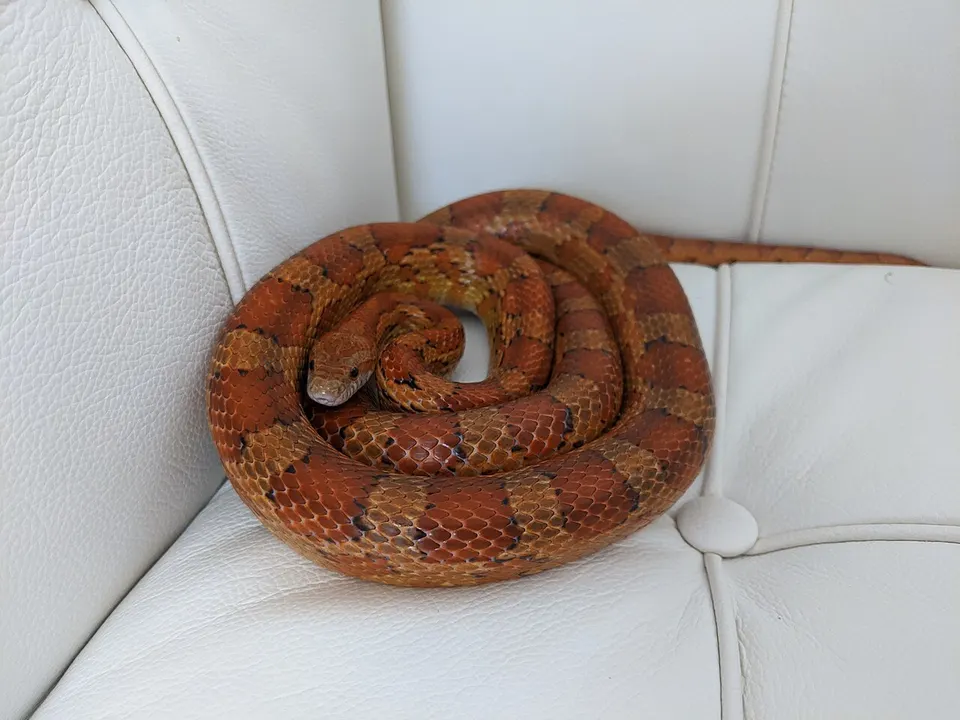
Quick Facts
| Attribute | Details |
|---|---|
| Scientific Name | Pantherophis guttatus |
| Origin | Southeastern United States |
| Size | 3-5 feet (90-150 cm) |
| Lifespan | 15-20+ years |
| Temperature Range | 75-85°F (24-29°C) |
| Humidity | 40-60% |
| Enclosure Size | 40-75 gallon for adults |
| Care Level | Beginner |
| Diet | Carnivore (rodents) |
| Temperament | Docile, Active |
Recommended for Corn Snakes
Affiliate links may earn a commission. Affiliate disclosure.
ZooMed - Heat mats and thermostats | ExoTerra - Escape-proof terrariums | Fluker's - Aspen bedding and supplies | Repashy - Vitamin supplements
Corn Snake Overview
The Corn Snake is often considered the ideal first snake, and for good reason. These beautiful North American colubrids are docile, hardy, excellent feeders, and come in an incredible array of colors and patterns. Their name comes from the checkered pattern on their belly resembling Indian corn, as well as their habit of hunting mice in corn cribs.
Corn snakes are constrictors that are more active than ball pythons while still maintaining a gentle temperament. They're curious, rarely bite, and are available in hundreds of stunning morph combinations.
Natural Habitat & Origin
Corn snakes are native to the southeastern United States.
- Range: New Jersey to Florida Keys, west to Louisiana and Tennessee
- Habitat: Pine forests, overgrown fields, abandoned buildings, rocky hillsides
- Behavior: Semi-arboreal, often found climbing trees and in elevated spaces
- Activity: Crepuscular to nocturnal, more active at dawn and dusk
- Climate: Temperate with seasonal temperature variations
Enclosure Setup & Requirements
Corn snakes need secure enclosures with climbing opportunities: Your exotic veterinarian and experienced Corn Snake owners can offer perspective tailored to your situation.
Tank Size
- Hatchlings: 10-gallon or small tub (too much space can be stressful)
- Juveniles: 20-gallon
- Adults: 40-75 gallon or 4x2x2 feet
- Key: Height matters - provide climbing space
Substrate Options
- Recommended: Aspen shavings (excellent for burrowing)
- Alternatives: Coconut fiber, cypress mulch, paper towels
- Depth: 2-3 inches for burrowing behavior
- Avoid: Cedar, pine (toxic oils), sand
Essential Furnishings
- Hide on warm side
- Hide on cool side
- Climbing branches (they love to climb!)
- Water dish (large enough to soak)
- Optional: Additional hides and foliage
Escape Artists!
Corn snakes are legendary escape artists, especially as hatchlings. Any gap larger than their head is a potential escape route. Secure all openings with clips or locks.
Temperature & Lighting
Corn snakes have moderate temperature requirements: Your exotic veterinarian and experienced Corn Snake owners can offer perspective tailored to your situation.
Temperature Requirements
| Zone | Temperature |
|---|---|
| Basking/Warm Side | 82-85°F (28-29°C) |
| Cool Side | 72-75°F (22-24°C) |
| Nighttime | 65-72°F (18-22°C) |
Heating Options
- Under tank heaters: Work well with aspen substrate
- Overhead heating: Ceramic heat emitters, radiant heat panels
- Thermostat: Required for any heat source
- Note: Room temperature homes may not need supplemental heat in summer
Lighting
Corn snakes don't require special lighting.
- Photoperiod: Natural room lighting or 12 hours on/off cycle
- UVB: Optional but may provide minor benefits
- Avoid: Colored bulbs or excessive light
Humidity & Water
Corn snakes are adaptable regarding humidity.
- Ambient humidity: 40-60%
- During shed: Increase to 60-70%
- Water dish: Fresh water always available, large enough for soaking
- Misting: Generally not necessary except during shedding
Diet & Feeding
Corn snakes are enthusiastic feeders on appropriately sized rodents.
Prey Size
- Guideline: Prey should be 1-1.5x the width of the snake's body
- Hatchlings: Pinky mice
- Juveniles: Fuzzy to hopper mice
- Adults: Adult mice or small rats (for larger females)
Feeding Schedule
- Hatchlings: Every 5-7 days
- Juveniles: Every 7-10 days
- Adults: Every 10-14 days
Feeding Tips
- Frozen/thawed: Safest option, thaw to room temperature
- Feeding response: Corn snakes rarely refuse meals (unlike ball pythons)
- Post-feeding: Don't handle for 48 hours after feeding
Health Issues & Common Problems
Corn snakes are hardy, but be aware of these issues: When in doubt, choose the guidance that names the Corn Snake explicitly over the guidance that treats all pets alike.
Respiratory Infections
Usually from cold, damp conditions. Signs: wheezing, open-mouth breathing, mucus. Requires veterinary antibiotics.
Mites and Ticks
External parasites appearing as tiny moving dots. Treat with reptile-safe mite treatment, clean and disinfect enclosure.
Regurgitation
Can occur from handling too soon after feeding, prey too large, or illness. Wait 2 weeks before next feeding attempt.
Stuck Shed
Usually eye caps or tail tips. Increase humidity, provide soaking opportunity.
Scale Rot
From overly wet conditions. Keep substrate dry and clean. May need topical treatment.
Internal Parasites
Wild-caught more commonly affected. Annual fecal exams recommended.
Handling & Temperament
Corn snakes are one of the best-tempered snakes available: The closer your routine tracks the Corn Snake's specific traits, the easier everything downstream becomes.
- Acclimation: Allow 1 week to settle before handling
- Temperament: Usually calm and curious, rarely bite
- Movement: Active handlers - they like to explore
- Duration: 15-30 minute handling sessions
- Frequency: Several times per week is fine
- Juvenile bites: Baby corn snakes may musk or nip but quickly calm down
- Avoid handling: 48 hours after feeding, during shed
Breeding Information
Corn snakes are one of the most commonly bred snakes.
- Sexual maturity: 18-24 months, 200+ grams
- Sexing: Probing or popping (by experienced handler)
- Brumation: 2-3 month cooling period (50-60°F) triggers breeding
- Clutch size: 10-30 eggs
- Incubation: 60-65 days at 78-84°F
- Morphs: Hundreds of color and pattern combinations available
Is This Reptile Right for You?
Corn Snakes Are Great For:
- First-time snake owners
- Those wanting a reliable feeder
- People who enjoy handling their pets
- Keepers interested in breeding and morphs
- Those with moderate space
Corn Snakes May Not Be Ideal For:
- Those in cold climates without heating ability
- People wanting a large snake
- Anyone uncomfortable with rodent feeding
- Those who can't secure an escape-proof enclosure
Cost of Ownership
| Item | Typical U.S. cost |
|---|---|
| Snake (captive-bred) | $40–$100 for common morphs |
| Enclosure setup | $250–$450 (4×2×2 ft adult enclosure, heat source on a thermostat, hides, secure lid) |
| Food | $2–$5 per frozen-thawed mouse, every 7–14 days for adults |
| Exotic vet exam | $60–$120 per visit |
A locking lid matters more than any accessory. Corn snakes are famous escape artists.
When to See a Vet: Red Flags
If you are deciding how fast to go, use the when-to-see-a-vet checker. It sorts urgent, soon, and monitor, and it is not a diagnosis.
Reptiles hide illness well, so by the time a corn snake looks sick it has often been unwell for a while. Book an exam with a reptile-experienced vet if you notice:
- Mouth gaping, mucus or wheezing.
- Regurgitation, or soft and discolored stools that last more than a few days.
- Swellings or lumps along the body.
- Mites (moving black dots) or a shed that comes off in patches.
- Refusing food for more than a month with visible weight loss, outside of a cool-season slowdown.
Corn snakes may eat less in winter or before a shed. Weigh them regularly rather than guessing.
Legal and Permit Notes
Captive-bred corn snakes are legal to keep in most of the U.S. without a permit. Corn snakes are native to the southeastern U.S., and several states protect wild-caught native snakes, so never take one from the wild. Buy from a breeder.
Corn Snake FAQ
How long do corn snakes live?
About 15 to 20 years in captivity, and some pass 20.
How big do they get?
Adults are typically 3 to 5 feet long and slender.
Do corn snakes bite?
Hatchlings may strike, but most adults become very tolerant of gentle, regular handling.
What temperature do they need?
A warm side around 85–88°F and a cool side around 72–78°F, controlled by a thermostat.
Vet and care references
- VCA Animal Hospitals: Snakes – Owning
- Merck Veterinary Manual: Reptiles
- Association of Reptile and Amphibian Veterinarians (find a reptile vet)
Related Species
- King Snake - Similar care, different patterns
- Milk Snake - Related, beautiful colors
- Ball Python - Calmer, less active
- Garter Snake - Smaller, different diet options
Ask Our AI About Corn Snakes
Have specific questions about Corn Snake care, morphs, or health? Our AI assistant can provide personalized guidance.
Get Personalized AI Guidance
Running the plan in real life shows you very quickly which pieces are load-bearing and which ones you can drop.
Ask Our AI Now