Oscar Fish
This page is educational reference material for preparing questions. A licensed veterinarian examines the animal, makes the diagnosis, and sets the treatment.
Affiliate links may earn a commission. Affiliate disclosure.
Quick Facts
| Attribute | Details |
|---|---|
| Scientific Name | Astronotus ocellatus |
| Origin | Amazon Basin, South America |
| Size | 12-14 inches (30-35 cm) |
| Lifespan | 10-20 years |
| Temperature Range | 74-81°F (23-27°C) |
| pH Range | 6.0-8.0 |
| Tank Size Minimum | 75 gallons for one, 125+ for pairs |
| Care Level | Moderate |
| Diet | Carnivore/Omnivore |
| Temperament | Semi-aggressive, Territorial |
Recommended for Oscar Fish
Aquarium Co-Op - Quality cichlid supplies | Seachem - Powerful filtration media | Fluval - Heavy-duty canister filters
Oscar Fish Overview
The Oscar fish is one of the most intelligent and personable aquarium fish available, often described as having the personality of a dog. These large South American cichlids are known for their expressive behavior, recognizing their owners, and even begging for food. Despite being commonly sold as small juveniles, Oscars grow rapidly and require substantial tank space.
Available in various color morphs including Tiger, Red, Albino, and Lemon, Oscars are impressive showpiece fish for dedicated keepers. Their intelligence, interaction with owners, and long lifespan make them rewarding pets for those prepared for their size and waste production.
Astronotus ocellatus is a large, messy South American cichlid, not a centerpiece for a community of tetras. The adult size is 12 to 14 inches. One oscar needs a minimum of 75 gallons. A pair needs 125 gallons or more. The lifespan is 10 to 20 years, so the tank you set up for a 3-inch juvenile is a long commitment, and the fish will outgrow every decoration you bought for the small body.
They recognize the people who feed them and they will come to the glass. They also rearrange the aquascape. Slate caves, loose swords, and a carefully planted foreground become a pile by the end of the week. Use heavy rock seated on the glass, or accept a bare tank with a few unmovable pieces. Anything that fits in the mouth is food. Tankmates that seemed large enough at the shop are not safe once the oscar is a foot long. Keep them with other big, robust fish or keep them alone.
Temperature is 74 to 81°F and pH is a wide 6.0 to 8.0. Hardness can run from 5 to 20 dGH. They are not fussy about a perfect blackwater number, and they are extremely fussy about waste. The diet is listed as carnivore and omnivore: pellets made for large cichlids, prawns, earthworms, and occasional greens. Feeder goldfish are a poor staple and bring parasites. Nitrate should stay under 40 ppm, and lower is better. Ammonia and nitrite at anything other than 0 ppm will burn the fins on a fish this messy, because one oscar produces more waste than a shoal of small community fish.
Natural Habitat & Origin
Understanding Oscar origins helps provide appropriate care.
- Native Range: Amazon River basin, including Peru, Brazil, Colombia, and Ecuador
- Habitat: Slow-moving rivers, flooded forests, and quiet backwaters
- Environment: Areas with submerged logs, branches, and vegetation
- Wild Behavior: Ambush predators feeding on smaller fish and invertebrates
Oscars have been introduced to other regions and are considered invasive in parts of Florida due to aquarium releases.
Tank Requirements & Setup
Oscars need substantial space and robust equipment.
Tank Size
- Single Oscar: 75 gallons absolute minimum, 100+ recommended
- Pair of Oscars: 125 gallons minimum
- With Tank Mates: 150+ gallons
- Growth Rate: Can grow 1 inch per month when young
Essential Equipment
- Powerful Filtration: Canister filters rated for 2-3x tank volume
- Heater: Robust heater with guard (Oscars may break equipment)
- Strong Lid: Oscars can jump and move decorations
- Heavy Decorations: Secured items that can't be moved
Decoration & Setup
- Substrate: Sand or large gravel (Oscars dig)
- Decorations: Large rocks, driftwood (must be heavy/secured)
- Plants: Generally destroyed - use hardy species or artificial
- Open Space: Provide swimming room
- Hiding Spots: Large caves or structures
Oscar Tank Essentials
Fluval FX Series - Heavy-duty canister filters | Seachem Matrix - Bio-media for high bioload | Aquarium Co-Op - Large sponge filters
Water Parameters
Oscars are adaptable but produce significant waste.
| Parameter | Ideal Range |
|---|---|
| Temperature | 74-81°F (23-27°C) |
| pH | 6.0-8.0 |
| Ammonia | 0 ppm |
| Nitrite | 0 ppm |
| Nitrate | <40 ppm (lower is better) |
| Hardness (GH) | 5-20 dGH |
Heavy Bioload Warning
Oscars are messy fish that produce substantial waste. Perform 25-50% water changes weekly. Overfiltration is recommended - you cannot have too much filtration for an Oscar tank.
Diet & Feeding
Oscars are primarily carnivorous with hearty appetites.
Primary Foods
- High-Quality Pellets: Cichlid pellets should be the staple
- Frozen Foods: Krill, silversides, shrimp, bloodworms
- Live Foods: Earthworms, crickets, mealworms (occasional)
- Fresh Foods: Raw shrimp, fish fillets
- Vegetables: Occasional blanched peas, zucchini
Feeding Guidelines
- Feed juveniles 2-3 times daily
- Feed adults once daily or every other day
- Remove uneaten food promptly
- Avoid feeder fish (disease risk, poor nutrition)
- Fast one day per week
Proper nutrition for Oscar Fish requires understanding not just what to feed, but how feeding strategies affect health, behavior, and water quality. A disciplined approach to feeding, where your Oscar Fish receives the right amount of appropriate food at consistent intervals, is one of the most impactful things you can do for both the fish and the overall aquarium ecosystem.
Diet variety is essential for optimal Oscar Fish health because no single commercial food provides the complete nutritional profile these fish require. Observing your Oscar Fish's response to different food types also provides useful health information, as reduced interest in normally preferred foods is often an early indicator of illness.
Behavior & Temperament
Oscars are known for their distinct personalities: Your aquatic veterinarian and experienced Oscar owners can offer perspective tailored to your situation.
- Intelligent: Among the smartest aquarium fish
- Interactive: Recognize owners and beg for food
- Territorial: Defend their space, especially when breeding
- Rearrangers: Move decorations and dig in substrate
- Predatory: Will eat anything that fits in their mouth
- Sometimes Aggressive: Can be bullies to tank mates
Temperament is semi-aggressive and territorial. Two oscars that grew up together in 125 gallons can work. Two adults introduced in a 75-gallon tank usually cannot. Spawning makes them more violent, and they will defend a flat stone even if you had no plan to breed them. Care is rated moderate because the filtration and the water changes are the real work. A canister that was adequate at 6 inches is not adequate at 14. Rinse mechanical media often and change water on a schedule you can keep for a decade.
Oscar Fish stable water parameters, appropriately measured feeding, and a consistent quarantine protocol carry most of the welfare signal; these factors drive outcomes more than brand-name products.
Feeding behavior in Oscar Fish reveals much about their ecological role and can be leveraged by keepers to promote natural behaviors and reduce aggression. Observing when, where, and how your Oscar Fish feeds provides diagnostic information about their comfort level, health status, and social standing. Many successful Oscar Fish keepers use varied feeding strategies including target feeding, scatter feeding, and enrichment feeders to promote natural foraging behaviors and reduce competition-related stress.
Compatibility with Other Fish
Oscar tank mates require careful selection.
Potentially Compatible Tank Mates
- Severum cichlids
- Jack Dempsey cichlids
- Firemouth cichlids
- Large plecos (common, sailfin)
- Silver dollars
- Bichirs
- Other Oscars (with caution)
Incompatible Species
- Any fish small enough to eat
- Slow-moving fish
- Long-finned fish (may be attacked)
- Most community fish
- Aggressive African cichlids
Breeding Information
Oscars can breed in home aquariums with proper conditions: Your aquatic veterinarian and experienced Oscar owners can offer perspective tailored to your situation.
- Sexing: Difficult - best to let them pair naturally from a group
- Spawning Surface: Flat rocks cleaned by the pair
- Egg Laying: 1,000-2,000 eggs per spawn
- Parental Care: Both parents guard eggs and fry
- Hatching: 3-4 days
- Fry Care: Parents may move fry to pits in substrate
- Fry Food: Baby brine shrimp, crushed pellets
Popular Oscar Varieties
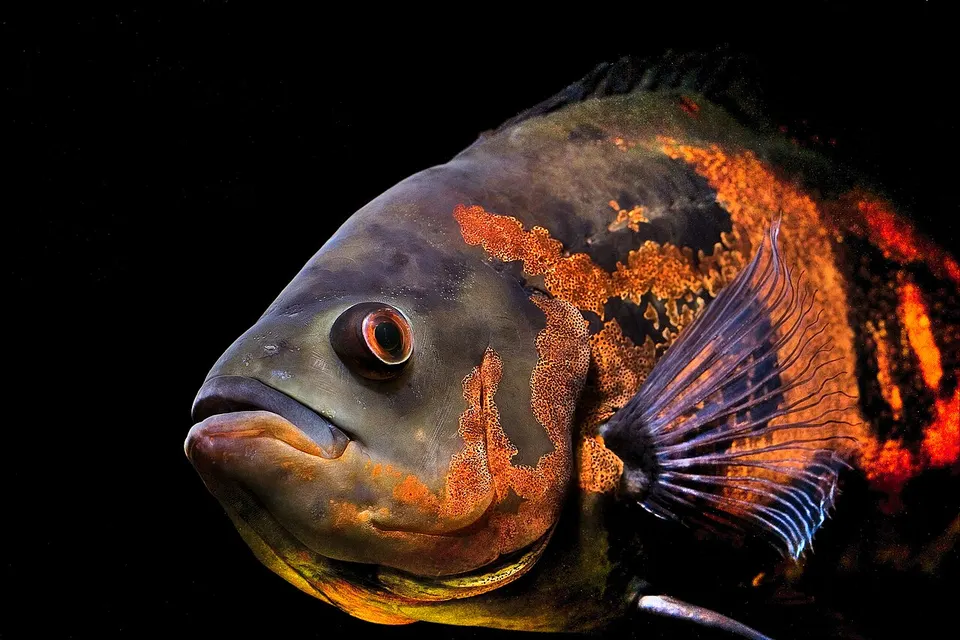
- Tiger Oscar: Classic red-orange and black pattern
- Red Oscar: Enhanced red coloration
- Albino Oscar: White/cream with red eyes
- Lutino Oscar: Yellow coloration
- Lemon Oscar: Yellow/gold base color
- Wild Type: Darker coloration with ocellus spot
Common Health Issues
Oscars are generally hardy but can develop several conditions: Every Oscar benefits from an owner willing to dig below surface-level recommendations.
Hole-in-Head Disease (HITH)
- Symptoms: Pits/holes forming on head and face
- Causes: Poor water quality, nutritional deficiencies, hexamita
- Treatment: Improve water quality, varied diet, metronidazole
Ich (White Spot Disease)
- Symptoms: White spots on body and fins
- Treatment: Raise temperature, ich medication, salt
Fin Rot
- Symptoms: Deteriorating, ragged fins
- Treatment: Water changes, antibacterial treatment
Bloat
- Symptoms: Swollen abdomen
- Causes: Overfeeding, constipation, internal parasites
- Treatment: Fast, Epsom salt baths, varied diet
Oscar Health Products
Seachem Paraguard - Disease treatment | API General Cure - Parasite treatment | Aquarium Co-Op - Quality fish foods
Keeping an Oscar healthy means prioritizing water quality above everything else.
Quarantine protocols represent one of the most impactful health management practices available to Oscar Fish keepers. This single practice prevents the majority of disease outbreaks in established aquariums and is considered essential by virtually all experienced Oscar Fish keepers.
Is This Fish Right for You?
Experienced Oscar owners often cite this as the factor they wish they had taken more seriously at the start.
Oscars Are Great For:
- Those wanting an interactive, pet-like fish
- Keepers with space for large tanks
- Hobbyists interested in intelligent fish behavior
- Those committed to regular maintenance
- Experienced fishkeepers
Oscars May Not Be Ideal For:
- Small tank setups
- Community tank enthusiasts
- Those wanting a low-maintenance fish
- Beginners unprepared for rapid growth
- Planted tank enthusiasts
Fishkeeping is one of those hobbies where patience pays dividends. Rushing to add an Oscar Fish to a new tank, skipping the cycling process, or cutting corners on filtration leads to predictable problems.
Cost of Ownership
Your actual costs for Oscar care will depend on where you live, your animal's health, and the choices you make.
The true cost of keeping Oscar Fish extends well beyond the initial purchase price and basic equipment. While the upfront investment in a properly equipped aquarium (minimum 75 gallons for one, 125+ for pairs) represents a significant portion of the total cost, ongoing expenses for water treatment chemicals, filter media, electricity for heating and lighting, and food constitute the majority of long-term spending. Many aspiring Oscar Fish keepers underestimate these ongoing costs, which can lead to cut corners that ultimately compromise fish health and result in even greater expenses. A realistic budget that accounts for both routine maintenance and occasional replacement of equipment provides a more accurate picture of what Oscar Fish keeping actually costs.
Once you understand the baseline, individual choices about diet, exercise, and preventive medicine follow more naturally
Related Species
If you're interested in Oscar fish, you might also consider.
- Angelfish - Smaller, more manageable cichlid
- Discus - Stunning South American cichlid
- Pleco - Common Oscar tank mate
- Ram Cichlid - Dwarf cichlid option
Ask Our AI About Oscar Fish
Have specific questions about Oscar care, tank setup, or health issues? Our AI assistant can provide personalized guidance.
Get Personalized AI Guidance
Jumping is common when the lights snap on or a lid is left off during feeding. A hood that can take a hit from a heavy fish is part of the setup. So is a heater guarded from being shoved into the glass. The personality is the reason people keep oscars, and it does not shrink the minimum. If 75 gallons for one fish, or 125 for a pair, is not available, this is the wrong cichlid.
Ask Our AI NowDecision Guides for Oscar Fish
Use these only when comparing food, insurance, ownership budget, or beginner fit for this specific pet.
Oscars, Astronotus ocellatus, are South American cichlids that commonly reach 12 inches and need about 75 gallons for one fish and 125 gallons or more for a pair. Feed a large pellet, earthworms, and krill. Feeder goldfish carry parasites and thiaminase. Hole-in-the-head pits get worse in dirty water and a narrow diet.