Gouramis
This page is educational reference material for preparing questions. A licensed veterinarian examines the animal, makes the diagnosis, and sets the treatment.
Affiliate links may earn a commission. Affiliate disclosure.
Quick Facts
| Attribute | Details |
|---|---|
| Scientific Name | Various (Trichogaster, Colisa, etc.) |
| Origin | Southeast Asia |
| Size | 2-6 inches depending on species |
| Lifespan | 4-8 years |
| Temperature Range | 74-82°F (23-28°C) |
| pH Range | 6.0-7.5 |
| Tank Size Minimum | 10-55 gallons (species dependent) |
| Care Level | Easy to Moderate |
| Diet | Omnivore |
| Temperament | Peaceful to Semi-aggressive |
Recommended for Gouramis
Aquarium Co-Op - Quality foods & plants | Seachem - Water treatment | Fluval - Aquarium equipment
Gourami Overview
Gouramis are elegant labyrinth fish from Southeast Asia, related to bettas and sharing their ability to breathe atmospheric air. This diverse group includes species ranging from the tiny sparkling gourami to the impressive giant gourami, with the popular dwarf and pearl gouramis falling in between.
Known for their graceful swimming, feeler-like pelvic fins, and often striking colors, gouramis are popular centerpiece fish for community aquariums. Most species are peaceful, though males can be territorial, especially during breeding.
Gouramis are labyrinth fish from South and Southeast Asia, related to bettas. Adult size on a group page runs about 2-6 inches depending on species, and a typical lifespan is about 4-8 years if the fish is the species you think it is. A sparkling gourami stays near 1.5 inches. A giant gourami does not. The pelvic fins are long feelers they use to touch the world. Do not trim them and do not house a long-finned variety with fin nippers. A lifespan of 4-8 years is realistic only for the species you actually bought, kept warm and fed.
Peaceful is not one temperament. Honey gouramis and sparkling gouramis are shy. Three-spot, gold, and opaline males become bullies in a small tank, especially while guarding a bubble nest. Keep one male of the larger species, give floating plants, and do not add a betta. A gourami gasping at the surface can be normal labyrinth breathing or it can be nitrite. Test the water before you call the gulp a personality. Plan the adult size, the vet, and the daily work for the gouramis before it comes home.
Keep the group at 74-82°F (23-28°C) and pH 6.0-7.5. Tank size on this page is minimum 10-55 gallons (species dependent): 10 gallons is a single honey or sparkling gourami, not a three-spot. The air above the water should be as warm as the tank, because they breathe it. A tight lid holds heat and stops a jump. Dwarf gourami iridovirus shows up as fading color, bloating, and a fish that wastes away. There is no cure. Do not buy the pale one because it is cheap.
Popular Gourami Species
Name the species before you buy the tank. Trichogaster lalius, the dwarf, is the iridovirus risk. Trichogaster chuna, the honey, is the calmer small gourami. Trichopodus trichopterus, the three-spot and its color forms, is the one that shreds a community.
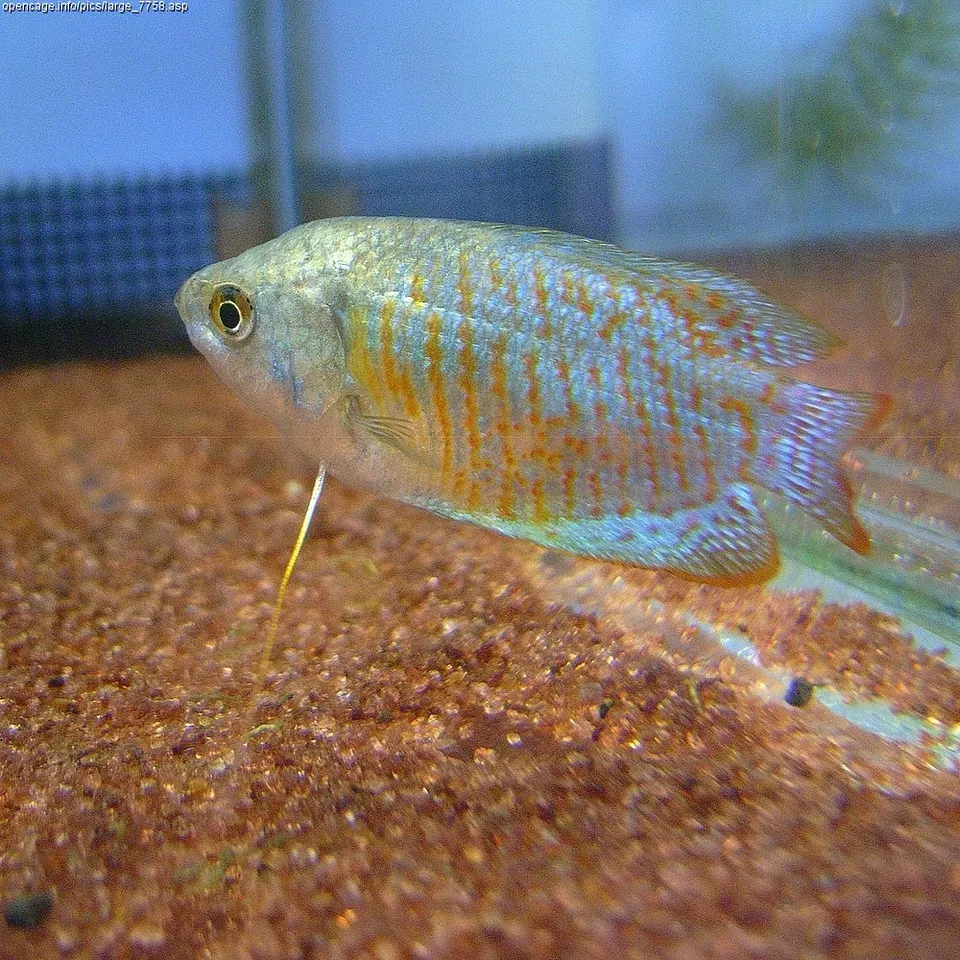
Dwarf Gourami (Trichogaster lalius)
- Size: 2-3 inches
- Tank Size: 10+ gallons
- Colors: Powder blue, flame, neon blue, red
- Temperament: Peaceful, shy
- Note: Prone to Dwarf Gourami Iridovirus
Pearl Gourami (Trichopodus leeri)
- Size: 4-5 inches
- Tank Size: 30+ gallons
- Colors: Pearl-like spots, orange chest in males
- Temperament: Very peaceful, excellent community fish
Honey Gourami (Trichogaster chuna)
- Size: 2 inches
- Tank Size: 10+ gallons
- Colors: Honey-gold, red
- Temperament: Very peaceful, shy
Three-Spot/Blue/Gold Gourami (Trichopodus trichopterus)
- Size: 4-6 inches
- Tank Size: 30+ gallons
- Colors: Blue, gold, opaline variants
- Temperament: Can be aggressive, especially males
Sparkling Gourami (Trichopsis pumila)
- Size: 1.5 inches
- Tank Size: 10+ gallons
- Colors: Iridescent spots
- Temperament: Peaceful, makes croaking sounds
Natural Habitat & Origin
Gouramis originate from Southeast Asian waters.
- Native Range: India, Pakistan, Bangladesh, Southeast Asia
- Habitat: Slow-moving or still waters - rice paddies, swamps, ditches
- Environment: Heavily vegetated, warm, often low-oxygen waters
- Adaptation: Labyrinth organ allows breathing atmospheric air
Tank Requirements & Setup
Gouramis thrive in planted, peaceful setups.
Tank Size (by species)
- Dwarf/Honey/Sparkling: 10+ gallons
- Pearl/Blue/Gold: 30+ gallons
- Multiple Males: Larger tanks needed
Essential Equipment
- Filter: Gentle flow - they prefer calm water
- Heater: Maintain stable tropical temperatures
- Lighting: Moderate, with floating plants for shade
- Lid: Labyrinth fish need humid air above water - leave gap
Decoration & Plants
- Live Plants: Essential - java fern, anubias, crypts
- Floating Plants: Water lettuce, frogbit (bubble nest sites)
- Hiding Spots: Important for shy species
- Open Areas: Swimming space in mid-levels
Water Parameters
Gouramis prefer warm, slightly acidic water.
| Parameter | Ideal Range |
|---|---|
| Temperature | 74-82°F (23-28°C) |
| pH | 6.0-7.5 |
| Ammonia | 0 ppm |
| Nitrite | 0 ppm |
| Nitrate | <20 ppm |
| Hardness (GH) | 4-15 dGH |
Diet & Feeding
Gouramis are omnivores that accept most foods.
Primary Foods
- Flake Food: High-quality tropical flakes
- Pellets: Slow-sinking micro pellets
- Frozen Foods: Bloodworms, brine shrimp, daphnia
- Live Foods: Brine shrimp, mosquito larvae
- Vegetables: Blanched spinach, zucchini
Feeding Guidelines
- Feed 2-3 times daily in small amounts
- Variety important for health
- They feed at surface and mid-level
Proper nutrition for Gouramis requires understanding not just what to feed, but how feeding strategies affect health, behavior, and water quality. A disciplined approach to feeding, where your Gouramis receives the right amount of appropriate food at consistent intervals, is one of the most impactful things you can do for both the fish and the overall aquarium ecosystem.
Diet variety is essential for optimal Gouramis health because no single commercial food provides the complete nutritional profile these fish require. Observing your Gouramis's response to different food types also provides useful health information, as reduced interest in normally preferred foods is often an early indicator of illness.
Behavior & Temperament
- Generally Peaceful: Most species are good community fish
- Male Aggression: Males can be territorial toward each other
- Feeler Fins: Use modified pelvic fins to explore
- Surface Dwelling: Frequently visit surface to breathe
- Bubble Nesters: Males build bubble nests for breeding
- Shy: Many species are timid, need hiding spots
Gourami is a shop-shelf name for several labyrinth fish, mostly Trichogaster and the species still sold under Colisa, from Southeast Asia. The card covers bodies from 2 to 6 inches and lifespans of 4 to 8 years, in tanks from 10 to 55 gallons depending on the species. Temperature is 74 to 82°F, pH 6.0 to 7.5, hardness 4 to 15 dGH. Diet is omnivore. The temper line admits both peaceful species and semi-aggressive ones, which is why a single care sheet keeps failing people. A honey gourami and a three-spot gourami are not the same roommate.
All of them breathe air at the surface with a labyrinth organ. A gap in the cover of floating plants, and a room that is not ice-cold above a warm tank, matters for every species on this page. A fish gasping at the surface may be using its labyrinth normally, or it may be in oxygen-poor water and in trouble. Look at the gills and the neighbors. If only the gourami is up top and it swims back down calmly, that is the organ. If it hangs there with clamped fins, test the water.
Dwarf gouramis, Trichogaster lalius, are the pretty 3.5-inch fish with the virus problem. Honey gouramis are a different, smaller, hardier species. Pearl gouramis get larger, carry a long feeler-like pelvic fin, and stay relatively peaceful. Three-spot gouramis and their cosby and gold color forms are the ones that turn into fin-nippers and bullies as they approach the upper end of the 2-to-6-inch range. A 10-gallon tank is a honey or a single dwarf. A three-spot belongs toward the 55-gallon end of this card, not in the dwarf's tank.
Males of the small species build bubble nests and will drive females that are not ready. One male and one female, with plants, is the usual pair. Two males of a nesting species in a small tank will shred fins. Feed a pellet, flake, and frozen foods. They are slow at the surface. Danios and barbs will take the meal. Choose tankmates that eat at a similar pace, or feed the gourami in the plants. Semi-aggressive, on this card, almost always means a male of the larger species, or a nesting male in a tank with no cover.
Four to 8 years covers a small honey that can live a long time and a larger gourami that often does not, because it was bought as a beginner fish and housed like a dwarf. Read the species before you trust the 10-gallon end of the tank range. The peaceful end of the temperament range is the honey and the pearl. The other end is the three-spot and a male dwarf cramped with another male. Beginner to moderate is the care line. Moderate is any gourami whose adult size you did not check, plus any dwarf from a farm that cannot talk about iridovirus.
Feeding behavior in Gouramis reveals much about their ecological role and can be leveraged by keepers to promote natural behaviors and reduce aggression. Observing when, where, and how your Gouramis feeds provides diagnostic information about their comfort level, health status, and social standing. Many successful Gouramis keepers use varied feeding strategies including target feeding, scatter feeding, and enrichment feeders to promote natural foraging behaviors and reduce competition-related stress.
Compatible Tank Mates
- Corydoras catfish
- Small peaceful tetras
- Rasboras
- Peaceful loaches
- Snails and shrimp (larger species)
- Other peaceful community fish
Incompatible Species
- Bettas (related, will fight)
- Fin nippers
- Very active, boisterous fish
- Large aggressive fish
- Multiple male gouramis in small tanks
Breeding Information
Gouramis are bubble nest builders.
- Bubble Nest: Males build floating nests
- Courtship: Male displays to female
- Spawning: Embrace under bubble nest
- Eggs: Male places eggs in bubble nest
- Parental Care: Male guards nest (remove female after spawning)
- Hatching: 24-48 hours
- Fry Care: Remove male when fry are free-swimming; feed infusoria
Dwarf Gourami Iridovirus (DGIV)
- Symptoms: Color loss, lethargy, wasting, sores
- Note: Primarily affects dwarf gouramis, no cure
- Prevention: Buy from reputable sources, quarantine
Ich
- Symptoms: White spots on body
- Treatment: Raise temperature, ich medication
Bacterial Infections
- Symptoms: Fin rot, ulcers, cloudy eyes
- Treatment: Clean water, antibacterial medication
Gourami Health Products
Seachem Paraguard - Disease treatment | API Stress Coat - Slime coat protection | Aquarium Co-Op - Quality foods
Keeping a Gouramis healthy means prioritizing water quality above everything else.
Recognizing early signs of disease in Gouramis requires a trained eye and consistent observation. Establishing a daily observation routine—even just a few minutes of focused attention during feeding—helps you develop a baseline understanding of what normal behavior looks like for your specific Gouramis, making deviations immediately apparent.
Quarantine protocols represent one of the most impactful health management practices available to Gouramis keepers. This single practice prevents the majority of disease outbreaks in established aquariums and is considered essential by virtually all experienced Gouramis keepers.
Gouramis Are Great For:
- Planted community tanks
- Peaceful aquarium setups
- Those wanting centerpiece fish
- Beginners (certain species)
Gouramis May Not Be Ideal For:
- Tanks with bettas
- Very active, boisterous tanks
- Those wanting multiple male gouramis together
- High-flow aquariums
The best way to decide if a Gouramis is right for your tank is to talk to people who already keep them. That kind of practical insight is more valuable than any care sheet.
A well-maintained Gouramis is one of the more satisfying species to keep, and most owners who take the time to get it right have no regrets.
Cost of Ownership
The fish is rarely the expensive part. A 10-gallon tank does not house the species that need 30 or 55 gallons, and replacing that setup is the real cost. Budget a heater, a lid, a test kit, and a quarantine container. A dwarf gourami that fades after a month is often iridovirus, and the money already spent on the fish does not buy a treatment. Minimum 10-55 gallons (species dependent) is the range to price, not a single starter kit. A sparkling gourami can live in the small end of that range. A three-spot or a giant cannot.
Heaters, filters, lights, and pumps all have finite lifespans, and their failure—particularly heater or filter failure—can have catastrophic consequences for Gouramis if not addressed promptly. Many experienced Gouramis keepers also invest in battery-operated air pumps and backup heaters as insurance against power outages, which can be lethal to tropical species within hours depending on ambient room temperature.
The cost-benefit analysis of quality versus budget equipment deserves careful consideration for Gouramis keepers. This is particularly true for Gouramis, where the animals themselves, along with any tank mates, plants, and established biological filtration, represent a significant investment of both money and time that is worth protecting with reliable equipment.
Related Species
- Betta Fish - Related labyrinth fish
- Angelfish - Similar care requirements
- Neon Tetra - Great tank mate
- Corydoras - Compatible bottom dweller
Ask Our AI About Gouramis
Have specific questions about gourami species, care, or tank setup? Our AI assistant can provide personalized guidance.
Get Personalized AI Guidance
Ask Our AI NowDecision Guides for Gouramis
Use these only when comparing food, insurance, ownership budget, or beginner fit for this specific pet.
Gouramis are labyrinth fish from slow Southeast Asian water. They breathe air at the surface, so a tight lid and a gap of warm moist air above the water matter, and a strong current exhausts them. Match the species. A sparkling gourami and a giant gourami need different tanks and different adult sizes.